
Most events Terrestream sees fit a known pattern: cooking, sleep, cleaning, off-gassing, smoke infiltration. The known patterns (see co-movement patterns) cover the common cases. When the data do not match any of them, Terrestream does not guess a cause.
The test is relative, not a fixed number. Terrestream compares each reading with that room's own recent baseline, so a rise that is normal in a busy kitchen can stand out in a bedroom. For CO2, it also learns each room's usual level for each hour of each day of the week and can tell you when CO2 is above that room's usual pattern. Known sensor quirks, such as high humidity inflating particle readings, are accounted for before anything is called unusual.
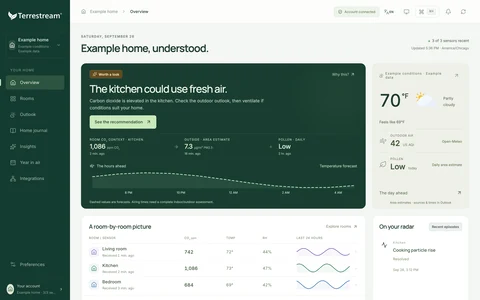
When a change is unusual, Terrestream shows it with the context it has: the readings that moved, the time of day, and outdoor conditions. For CO2 above a room's usual pattern, the suggestion is to check for blocked vents or extra people in the room. Recurring unexplained changes are often specific to your household: an HVAC quirk, a neighbor's routine, a slow seasonal shift.
Unusual changes are not alarms. They are observations, and most resolve on their own. Persistent unexplained changes are worth investigating with a walkthrough; they sometimes turn up real problems (a hidden moisture source, a worn HVAC filter, an unvented appliance) that no single reading would have caught. If you smell gas, leave and call your gas utility: Terrestream does not detect natural gas or carbon monoxide.
References
- Sensirion - SEN66 datasheet and VOC index info sensirion.com
- Fonollosa et al. - Drift counteraction in metal-oxide gas sensor arrays doi.org
- AHAM Verifide - Air filtration standards (CADR) ahamverifide.org
- EPA - AirNow: AQI Basics www.airnow.gov