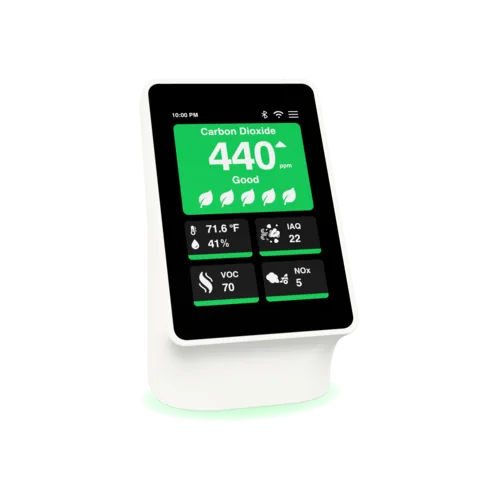
Set up your Terrestream
Set up with the mobile app, a computer, or use the sensor on its own.

Guides & support
Set up your sensor, connect your home, and make sense of your air.
Tagged: On the deviceBrowse all guides
1–12 of 40 guides
Set up with the mobile app, a computer, or use the sensor on its own.
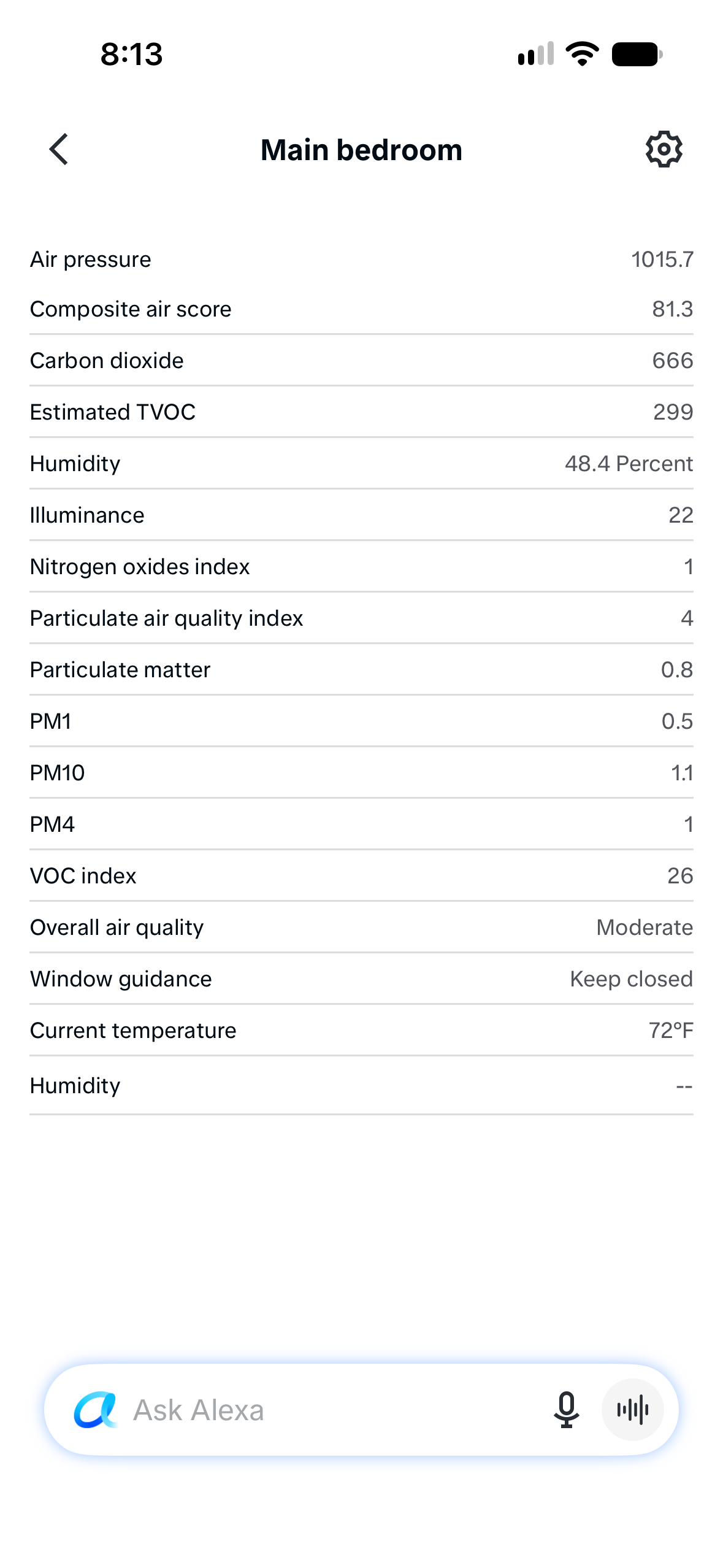
Enable the Terrestream skill, choose your sensors and set up readings and routines. US English.
One number for particles: the worse of the PM₂.₅ and PM₁₀ sub-indices, on the same 0–500 scale as the U.S. EPA AQI. It does not include CO₂, VOCs or NOₓ.
Every exhale adds CO₂ to a room. Rising readings can help you spot when ventilation is falling behind occupancy; they do not diagnose symptoms or concentration problems.
Particles smaller than 2.5 micrometers slip past your nose, lodge deep in the lungs, and cross into the bloodstream. They are the single most-studied air pollutant.
Larger particles that mostly get filtered in the upper airway, but they still matter for allergies, asthma, and visibility.
Volatile organic compounds are the carbon-based gases evaporating off everything: cooking, candles, paint, new furniture. Some are merely annoying. Some are not.
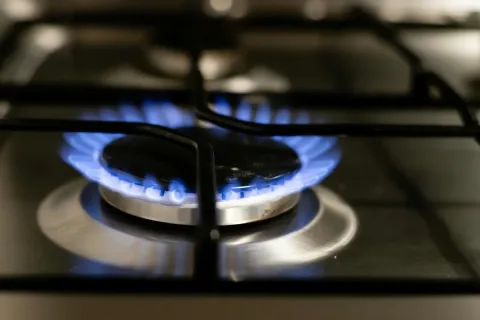
Nitrogen oxides come from combustion. Indoors, the main source is a gas stove. The health link with childhood asthma is robust.
Below 30%, your throat dries out and viruses last longer. Above 60%, mold and dust mites thrive.
ASHRAE defines a comfort zone. The bedroom is its own special case: cooler is better.
Pressure rarely changes how the air feels, but it changes how the body feels. It is also the most reliable indoor weather forecast you have.
Light is information your body uses to set its clock. Most indoor environments give it the wrong information.
CO₂ is read by pulsing infrared light the gas absorbs and listening for the pressure wave. VOCs are read by watching a hot ceramic surface change conductance. Different physics, different limits.
Every sensor has things it sees that it shouldn't. Knowing the cross-sensitivities is how you read the right story in the numbers.
Counter-height, away from vents and windows, in the room you actually use. The placement choice changes what you can interpret.
The single most consequential daily decision the dashboard helps you make. Six outdoor signals, three indoor signals, one answer.
You can't replace the HVAC, but you can do most of what matters. Eight interventions that need no landlord permission.
The dashboard interprets your air. It does not diagnose you, replace your doctor, or detect things the sensor cannot measure.
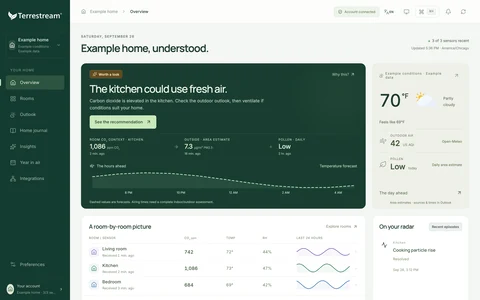
Product preview · Example data
How to read the dashboard and the apps: what band, baseline, spike, trend, anomaly, fingerprint, confidence and cross-reference mean.
When a reading is far outside what is usual for that room, Terrestream flags it and suggests what to check instead of guessing a cause. That is by design.
Two sensors tell more than one twice. The difference between rooms is often where the real story is.
Time of day is a meaningful signal: many air-quality readings rise and fall with the sun and with the household's daily routine.
A sealed empty home behaves predictably while you are gone. The first 24 hours back tells you what changed.
Every reading on the dashboard has a source: a sensor on the device, a computation from sensor inputs, or an outdoor API. Knowing which is which is the first step in interpreting any of them.
Accuracy, repeatability, and drift are different things, and each channel in the Sensirion SEN66 behaves differently over the years. Here are the datasheet figures with their conditions, and what to do when a reading looks wrong.
Sensors fail in a small set of recognizable ways. When a reading looks stuck, Terrestream holds alerts based on it. Here is how to tell a real spike from a glitch.
Three sensor packages, six sensing elements, twelve signals. Here is what is inside the device, what each part measures, and the physical reasons it can and cannot do what it does.
Lux helps interpret placement, daylight, display behavior, and occupancy patterns. It is not proof of circadian lighting performance or WELL lighting compliance.
A brief fan sound on the first Tuesday of the month is normally the SEN66 sensor self-clean cycle.
Use Quiet Hours and device/app settings to reduce display, light, and sound behavior on a schedule.
Factory reset clears saved device configuration, claim, and account-linking information so the sensor can be paired again. Do it before you sell, give away, or recycle the device.
A fair, sourced buyer guide to Terrestream, AirGradient ONE, Ruuvi Air, Awair Element, Airthings View Plus, Aranet4 HOME, Kaiterra Sensedge Mini, and IQAir AirVisual Pro.
Awair Element is a compact five-factor monitor; Terrestream adds broader particulate sizing, NOx, pressure, light, and deeper interpretation.
Airthings View Plus is compelling when radon is central; Terrestream emphasizes multi-signal indoor behavior and local-friendly workflows.
Aranet4 HOME is a focused portable CO₂ monitor; Terrestream is a broader room air-quality system.
IQAir AirVisual Pro emphasizes PM2.5, CO₂, AQI, and a large color display; Terrestream adds more indoor channels and source interpretation.
AirGradient ONE is an open-home indoor monitor with strong local-home appeal; Terrestream emphasizes polished room interpretation, commercial evidence, and buyer-ready guidance.
Ruuvi Air is a credible open-friendly SEN66 monitor; Terrestream emphasizes Wi-Fi-direct operation, a touchscreen display, outdoor-data fusion, and US buyer readiness.
PurpleAir is strongest as a particle and outdoor-map ecosystem; Terrestream is built for indoor room decisions across particles, gases, comfort, context, and recommendations.
Apollo AIR-1 is a compact ESPHome/Home Assistant monitor with strong local-control appeal; Terrestream emphasizes a finished room device, broader buyer guidance, and included cloud intelligence.
Search the knowledge base.