
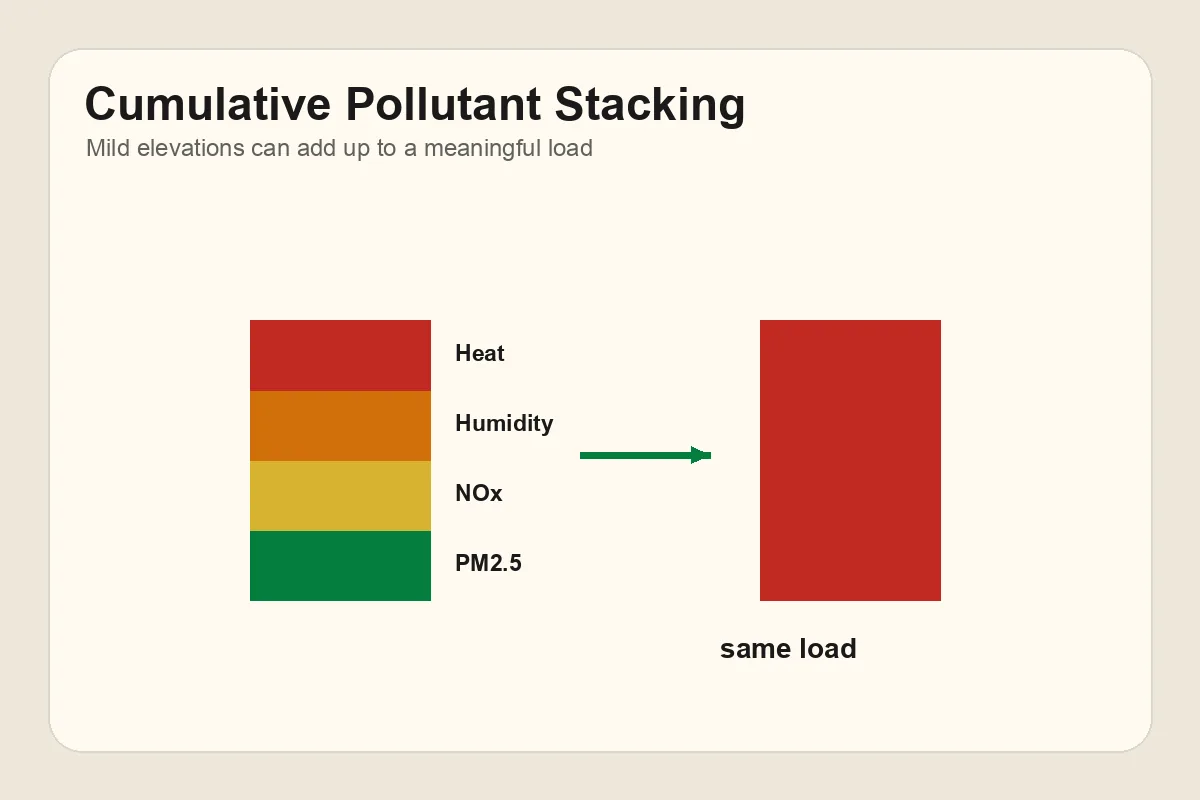
Public-health guidelines are written one pollutant at a time. WHO 2021 sets a PM2.5 24-hour limit, a separate NO2 annual limit, a separate ozone 8-hour limit, and so on, and a household that sits below every individual limit is treated as "compliant." That framing is convenient for regulation but it underrepresents what happens to the respiratory and cardiovascular systems when several pollutants sit at the moderate band of their own scales simultaneously. The body is not running the comparison one channel at a time.
The literature on co-exposure suggests at least three modes of interaction. Additive: PM2.5 plus NO2 produce the sum of their effects on lung inflammation, which is a baseline assumption and the easiest to model. Synergistic: ozone plus PM2.5 produce more inflammation than the sum, because oxidized particle surfaces are more reactive than either alone. Conditional: high humidity worsens the airway response to NO2, warm temperature accelerates VOC off-gassing from materials, and a cold wet day with closed windows traps everything that is being emitted. WHO and EPA both acknowledge this implicitly by setting separate limits per pollutant rather than a single combined index, but the household has to do the integration itself.
Here is what stacked-mild looks like on the dashboard. A weekday evening in winter: PM2.5 at 12 µg/m³ (above the WHO 24-hour guideline of 15 by morning if the trend continues), NOx index at 130 after a gas-stove dinner (elevated but not alarming on its own), RH at 65% (above the comfort band), temperature at 23 °C, and the windows have been closed since outdoor PM hit 40 µg/m³ in the afternoon. No single channel is dramatic. Together they are a room that an asthmatic or a person with cardiovascular disease will feel within an hour, and a healthy adult will feel as "stuffy and slightly off" without being able to name why.
The AI handles this by listing the contributors rather than collapsing them to a single score. When three or more channels are simultaneously in their moderate-but-elevated band, the recommendation surfaces all of them and then ranks by leverage: which intervention reduces the most channels at once. Running the range hood plus cracking a window often clears NOx, PM2.5, and humidity together; running a HEPA only clears PM. The highest-leverage move usually wins, and the AI says why. See interaction effects for the mechanism, co-movement patterns for how the dashboard detects stacking automatically, and dose for what the integral over time looks like.
This is environmental information, not medical advice. The dashboard's readings help you make decisions about the air in your space. They do not diagnose conditions, interpret symptoms, or replace conversations with your physician. If symptoms persist, worsen, or coincide with a known exposure, talk to a healthcare professional. See the AI's medical-advice scope.
References
- WHO Global Air Quality Guidelines (2021) www.who.int
- ASHRAE Standard 62.2 - Residential ventilation www.ashrae.org
- EPA - National Ambient Air Quality Standards for PM www.epa.gov
- Landrigan et al. - Lancet Commission on pollution and health doi.org