
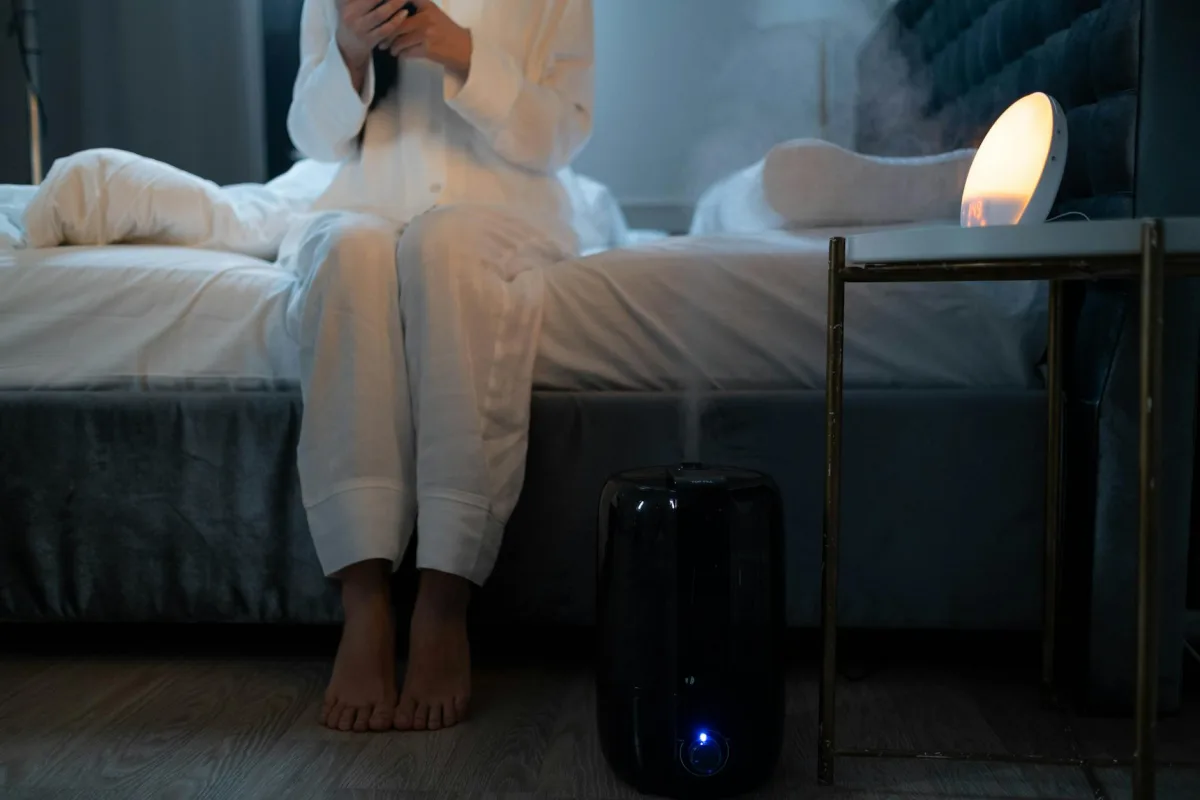
Three humidifier technologies, three risk profiles. Ultrasonic units use a piezoelectric diaphragm vibrating at megahertz frequencies to atomize water into a sub-micron mist; whatever is dissolved or suspended in the reservoir gets carried into the room air as aerosol, including bacteria, mineral content, and any organic contamination. Evaporative wick units pull water up through a porous filter and evaporate it with a fan; the filter itself can grow biofilm, but the airflow is filtered evaporation rather than aerosolized water, so bacterial-aerosol transmission is much lower than ultrasonic. Warm-mist (boiler/steam) units heat the water to boiling before releasing it; the heat kills most bacteria during the boil cycle, so this is the lowest-risk technology even on long-neglected reservoirs. The CDC and NIOSH consistently rank ultrasonic and impeller (spinning-disk) humidifiers as the higher-risk options, with warm-mist as the conservative choice for high-risk users.
The Legionella connection is documented. Legionella pneumophila is the bacterium responsible for Legionnaires' disease (a severe pneumonia, 10% fatality untreated) and Pontiac fever (a milder flu-like syndrome). It grows in stagnant warm water between roughly 20 and 50°C, especially in the presence of biofilm or scale. The transmission route is aerosolized droplets inhaled into the lower respiratory tract; person-to-person transmission does not occur. The WHO Legionellosis fact sheet documents the canonical sources: cooling towers, hot tubs, shower heads, decorative fountains, and humidifiers. Ultrasonic humidifiers in particular have been implicated in clinical outbreaks because they produce exactly the droplet size (1-5 µm) that bypasses upper-airway defenses and deposits in the alveoli. A neglected ultrasonic reservoir running at room temperature can grow Legionella over days to weeks; running it then disperses the aerosol throughout the room.
The "white dust" phenomenon is the canary. If you run an ultrasonic humidifier with hard tap water, the dissolved minerals (calcium, magnesium, dissolved silica) get aerosolized along with the water, the water evaporates in the room, and the minerals settle as a fine white film on furniture and electronics. The same aerosol shows up on the dashboard's PM2.5 channel as a sustained elevation during operation, often 10-30 µg/m³ above baseline depending on water hardness and unit output. If you see PM2.5 climb when your humidifier runs, that is mineral aerosol; the same physics is delivering whatever else is in the reservoir, including microbes. The dashboard cannot distinguish mineral dust from bacterial bioaerosol (the SEN66 is a mass-based counter, not a speciating instrument), but the presence of one is a strong indication of the conditions that allow the other. The mineral dust is not itself a major health risk for most adults; the implicit reservoir-quality signal is the part to pay attention to.
Maintenance protocol that actually keeps an ultrasonic unit safe. Water: use distilled or demineralized water only (eliminates mineral aerosol and reduces dissolved-organic load that biofilms feed on). Daily: empty the reservoir, rinse, and dry before refilling, never leave standing water in a warm room overnight. Weekly: disinfect with a 1:50 household-bleach dilution or with white vinegar, scrub the reservoir and the transducer, rinse thoroughly. Replace wicks, filters, and antimicrobial cartridges on the schedule the manufacturer specifies, not when they look dirty. Who should be more conservative: immunocompromised, infants, elderly, anyone on immunosuppressive medication, anyone with chronic lung disease, see raising indoor humidity for the comfort-side question and mold spores for the related biofilm question. For households where the conservative path is appropriate, switch to a warm-mist humidifier or use an HRV with a humidity recovery core instead of a standalone unit. For the air-quality context generally see humidity, PM2.5, and pets and IAQ sensitivity (pets are a separate aerosol-sensitive population). For when bacterial sampling needs a professional see when to call a pro.
Reminder: Terrestream is not a life-safety device. It is not a carbon-monoxide alarm, not a smoke alarm, not a combustible-gas detector, not a radon monitor. The readings here characterize chronic and acute air quality for decisions and trends; they do not replace UL-listed dedicated alarms or professional testing. See what the sensor cannot warn you about.
References
- CDC - Legionella (Legionnaires' disease) www.cdc.gov
- WHO - Legionellosis www.who.int
- EPA - Mold and health (humidity) www.epa.gov
- CDC NIOSH - Humidifier lung www.cdc.gov