
The winter-dry-indoor-air phenomenon is straightforward thermodynamics. Cold outdoor air holds very little water (cold air saturates at low absolute humidity), heating that air indoors does not add water (just temperature), so relative humidity drops sharply. A 30°F day at 70% outdoor RH becomes a 68°F indoor space at ~20% RH if the building exchanges air freely. Indoor RH below 30% is the source of static-shock weather, dry skin, dry mouth, cracked lips, and the seasonal uptick in respiratory virus transmission.
Portable humidifiers are the easiest and cheapest option for one to three rooms. Two technologies: evaporative (a wick passively wicks water; a fan blows over it) and ultrasonic (vibrates water into a fine mist). Evaporative is the safer choice for IAQ because it cannot put dissolved minerals or microbial contamination into the room as easily; ultrasonic units that run on hard tap water deposit "white dust" (mineral residue) measurable as PM2.5 on the dashboard. If you use an ultrasonic, use distilled water and clean weekly.
Whole-house humidifiers integrate with HVAC and are the right answer for tight homes in cold climates. Three types: bypass (uses HVAC airflow to evaporate water across a pad), fan-powered (own fan to push air across the pad), and steam (boils water into vapor). Steam is the most precise but the most expensive. Whole-house units need annual maintenance (pad replacement, descaling) and a working humidistat; without one, they can drive humidity well past 50% and cause condensation on cold-side windows and inside wall cavities.
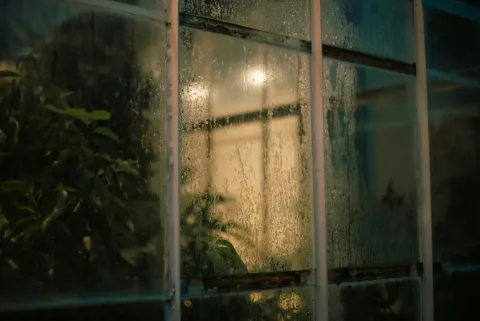
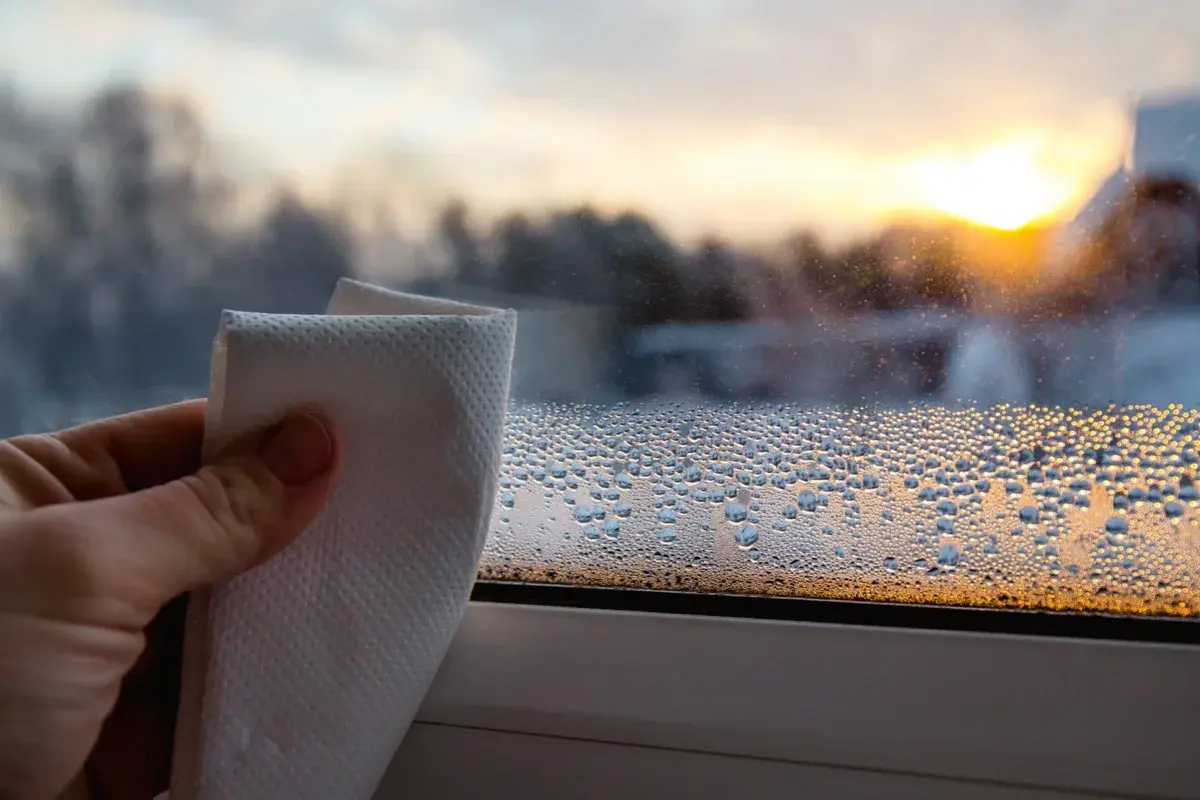
Target: 35-45% RH in winter, not higher. Above 50% in cold weather, condensation forms inside windows, in wall cavities at the cold-side vapor barrier, and on the cold corners where walls meet ceilings. That condensation feeds mold over weeks, often invisible until staining appears. The dashboard's humidity card combined with the outdoor-temperature reading is the right diagnostic for whether your current setpoint is causing condensation: indoor RH near 50% during a 10°F night almost certainly is. See sleep apnea for the specific case where humidity management is therapy-relevant, and reducing humidity for the inverse problem.
This is general guidance, not a substitute for professional assessment of your specific home. Major interventions (HVAC redesign, sealing a leaky envelope, mold remediation, electrical work for fans or venting) should be done with a certified professional. For chronic problems that don't respond to the steps here, see when to call a pro.
References
- EPA - Indoor air quality basics www.epa.gov
- ASHRAE Standard 55 - Thermal Environmental Conditions www.ashrae.org
- CDC / NIOSH - Indoor environment & temperature www.cdc.gov
- WHO - Indoor air quality: dampness and humidity www.who.int