Reducing CO₂ indoors: the ventilation ladder
CO₂ is what people exhale. The only durable answer is moving more outside air in. First find out why it stays high, then work the cost-ordered ladder, from free to capital project.

Guides & support
Set up your sensor, connect your home, and make sense of your air.
Tagged: MitigationBrowse all guides
1–12 of 19 guides
CO₂ is what people exhale. The only durable answer is moving more outside air in. First find out why it stays high, then work the cost-ordered ladder, from free to capital project.
Indoor NOₓ comes from combustion. The intervention hierarchy starts with eliminating sources and ends with capture-and-exhaust for what remains.
Two levers: stop making fine particles, and remove them when they appear. Start by asking whether the particles come from outside or from a source in the room.
PM10 settles faster than PM2.5 and is more about deposited dust than airborne particles. Walk-off mats, damp methods, and HEPA-vacuuming carry most of the load.
VOCs are easiest to manage by not introducing them. When you cannot avoid them, ventilation and bake-out are the durable tools, and a VOC index that won't settle usually has one of four causes.
The 30–50% RH band is the IAQ sweet spot. Above 60% RH for sustained periods, mold and dust mites become a problem. When humidity is stuck outside the band, four causes cover almost every case.
Cold outdoor air holds little water; once heated indoors, RH drops below 30%. Static, dry skin, respiratory symptoms, and infection-transmission risk all rise.
Indoor ozone comes mostly from outdoor infiltration on bad-air days. The playbook is window timing, building-envelope sealing, and avoidance of ozone-emitting devices.
SO₂ is almost entirely outdoor-driven from coal combustion, port shipping, oil refining, and volcanic emissions. The playbook overlaps PM2.5 plus SO₂ specifics.
A leaky house exchanges air the wrong way: cold drafts, dust infiltration, radon, outdoor ozone. Seal first, then add controlled ventilation. The order matters.
Task-specific exhaust handles the worst pollutant sources at their origin. Sized correctly and ducted to outdoors, it does more than whole-house ventilation can.
You do not need an HRV and three air purifiers to improve indoor air. The first $0 to $200 of effort delivers most of the gains. Here is the ladder, ordered by impact per dollar.
Every cubic foot of outside air you bring in is air you have to heat or cool. In some climates "just open windows" is correct; in others it is the most expensive intervention you can pick.
Most IAQ problems are DIY. A handful are not. Here are the triggers that say "stop, hire a credentialed professional", and how to choose one.
A wildfire-smoke event runs better when the supplies are already on the shelf and the envelope is already tight. Here is the May-through-September checklist, sized to a typical western-US household.
Replacing the gas stove with induction, the gas water heater with a heat pump, and the gas furnace with a heat pump removes the three largest indoor combustion sources at once. The IAQ delta is visible on the dashboard; the financial picture has shifted with new federal credits.
During hard exercise you move three to ten times more air through your lungs than at rest. Whatever is in that air gets the same multiplier. Home gyms and yoga rooms deserve their own ventilation plan.
Once the air clears outside, the ash that settled on every horizontal surface during the smoke event becomes the next problem. The cleanup protocol matters because dry sweeping puts everything you tried to keep out back into the air.
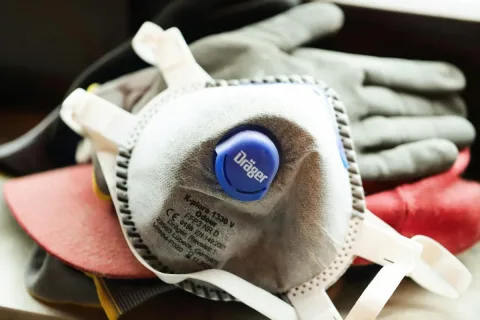
A particle-filtering respirator is the one piece of protection a HEPA at home cannot give you. Here is what each rating means and when each one is the right tool.
Search the knowledge base.