
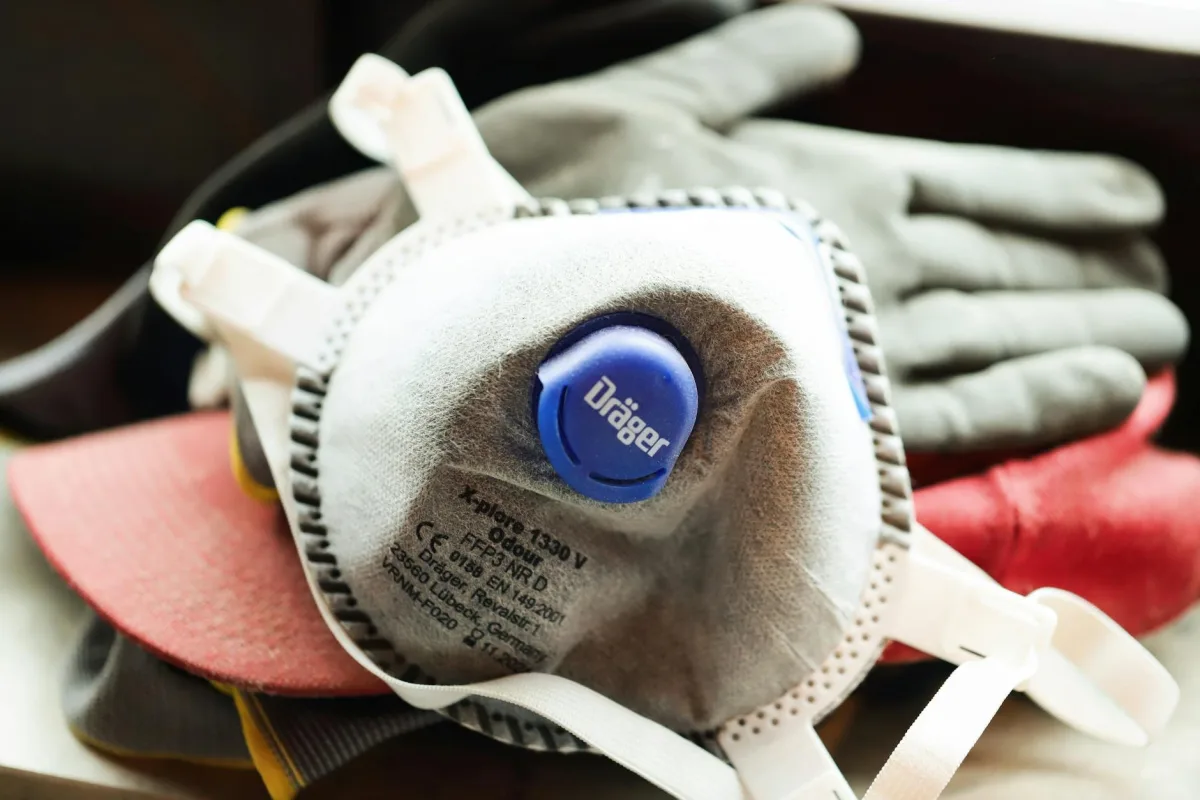
The category is bigger and less interchangeable than most people think. An N95 is a US NIOSH-certified respirator that captures at least 95% of 0.3 µm particles when properly sealed. A KF94 is the South Korean equivalent at 94% (Korean MFDS standard) with a typical fold-flat ear-loop design that many people find more comfortable for long wear. A KN95 is the Chinese GB 2626 standard at 95%, but the import market is rife with counterfeits, so verification against the manufacturer's NIOSH-equivalent listing is the only safe path. A surgical or procedure mask is designed primarily for fluid resistance during medical work, with particle-filtration as a secondary characteristic; it captures roughly 30-70% of fine particles depending on fit. A cloth mask captures roughly 10-30% of fine particles, useful as a barrier to large droplets but inadequate for wildfire smoke or workshop dust.
Fit matters more than rating. A perfectly-rated N95 worn with gaps at the nose or chin leaks 50% of inhaled air around the seal, reducing effective protection to the level of a loose surgical mask. The cup-shape and duckbill designs are easier to seal for most face shapes; fold-flat ear-loop designs (most KF94s) often leak more around the cheeks. Pinch the nose-piece firmly, run a finger around the edge to feel for air movement on exhale, and choose a different model if you cannot get a seal. Beard hair under the seal breaks it completely; for workshop or wildfire work, shaving is the practical answer for the duration.
When to wear which. Wildfire smoke: N95 or KF94 outdoors when outdoor PM2.5 is above 35 µg/m³; both work, KF94 often more wearable for hours-long exposure. Indoor air-quality events at home: usually unnecessary if you have a working HEPA, see wildfire smoke. Woodworking and 3D printing: N95 minimum for sanding; N100 or P100 for fine sanding of hardwoods or for ABS printing (the latter releases ultrafine particles that strain the higher efficiency rating). Respiratory illness exposure: N95 or KF94 in crowded indoor spaces during high-circulation periods. Light dust during normal cleaning: a surgical mask is enough.
Reusability and storage. Disposable N95s are designed for single-shift use in clinical settings, but the filter material is still effective for many hours of intermittent personal use; the limiting factor is the seal and the elastic straps degrading. Store between uses in a clean paper bag, hung in air, not crumpled into a pocket. Replace when the elastic loses tension, when the nose-piece no longer holds shape, or when the inside is visibly soiled or damp. For long-term household preparedness (see wildfire season preparedness), buy a box per family member at the start of fire season; the CDC/NIOSH respirator guidance explains how to identify approved respirators.
This is general guidance, not a substitute for professional assessment of your specific home. Major interventions (HVAC redesign, sealing a leaky envelope, mold remediation, electrical work for fans or venting) should be done with a certified professional. For chronic problems that don't respond to the steps here, see when to call a pro.
References
- CDC NIOSH - N95 respirators (NPPTL) www.cdc.gov
- CDC NIOSH - Respirators and masks (NPPTL) www.cdc.gov
- FDA - N95 respirators and face masks www.fda.gov
- CDC/NIOSH - Respirator guidance www.cdc.gov