

The math is simple. For any pollutant the device reads indoors and the outdoor feed reports for your location, divide indoor by outdoor on the same time window. A 24-hour average is best for envelope-baseline questions; a 1-hour average is better for active events like a wildfire-smoke push or an ozone afternoon. The ratio is unitless, and that is the point: it removes the absolute scale of the event and isolates what your building is doing about it.
Typical bands for PM2.5, the most diagnostic species. Below 0.3 means a tight envelope with active filtration: HEPA running, MERV-13 in the HVAC, doors and windows closed, no significant indoor sources. 0.3 to 0.6 is moderate: either decent envelope without portable HEPA, or HVAC running on its stock filter with normal infiltration. 0.6 to 0.9 is cracked windows or a leaky older home with no filtration assist. Near 1.0 means windows are open, or the envelope is so leaky it might as well be. Above 1.0 is the alarming case: indoor concentration exceeds outdoor, which means there is a source inside. Investigate.
Per-pollutant subtleties matter. PM ratios are cleanest because particles do not chemically transform between outside and inside. Ozone is different: typical indoor/outdoor ozone ratios sit at 0.2 to 0.4 even with windows closed, because ozone reacts with indoor surfaces (skin, fabrics, paint) within minutes. CO2 inverts the whole framework: outdoor is near 420 ppm and indoor is almost always higher because people exhale; the diagnostic question for CO2 is "how much higher than outdoor," not "what ratio." NO2 ratios are dominated by indoor combustion (gas stoves) when present; without an indoor source, the ratio runs at roughly 0.5 to 0.8 in homes near traffic.
Limits to keep in mind. The ratio assumes both readings are valid; a drifting sensor, a humidity-confused PM count, or a stale outdoor feed will all break it. The nearest outdoor monitor may be 5 to 30 km away, so during a hyperlocal event the ratio can mislead. And short averaging windows are noisy: a single passing truck or a one-minute candle burst can swing the 5-minute ratio dramatically. Use the ratio as a slow signal, average over hours, and pair it with co-movement patterns to confirm what is driving the number.
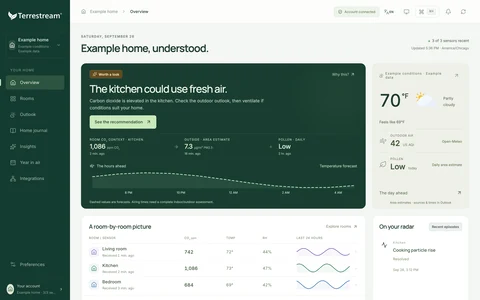
Terrestream Intelligence · near you
Today's air conditions in Columbus
Situation
Smoke nearby · example home response
Smoke advisory conditions · AQI 62 · PM2.5 15 µg/m³ · 41° · near Columbus
Outdoor AQI · Open-Meteo · 17 min ago
Outdoor smoke information can prompt a closer look indoors. The sample readings below illustrate a possible particle increase; outdoor data alone cannot confirm smoke inside your home.
- PM2.5 (indoor) 12 µg/m³ Moderate
- CO₂ (indoor) 760 ppm Moderate
Suggested response Now
Closing up and filtration may help
- Consider closing windows
- Consider an air cleaner
Closing windows and doors, using an air cleaner, and limiting indoor particle sources may help reduce incoming and indoor-generated particles. Follow official local guidance.
For health guidance and any stay-indoors or evacuation instructions, follow AirNow and your local authorities.
Illustration: outdoor conditions are real, approximate-area data; indoor readings are modeled, not measured. No device is reporting from your home. Not medical advice.
References
- ASHRAE Standard 62.2 - Residential ventilation www.ashrae.org
- LBNL - Building envelope publications buildings.lbl.gov
- DOE - Weatherization Assistance Program www.energy.gov
- EPA - Indoor air quality basics www.epa.gov