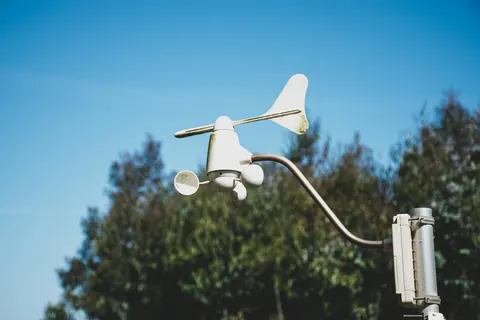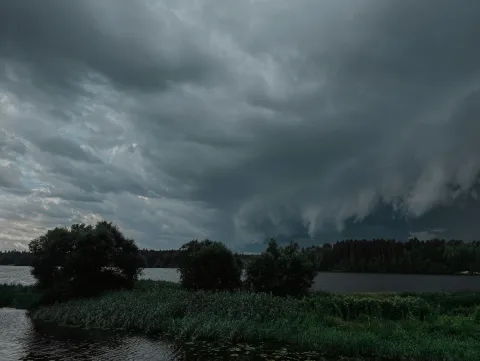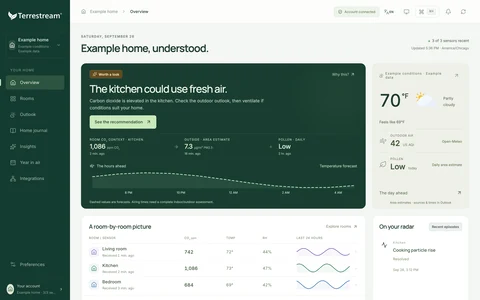


The outdoor feeds include not just current readings but forecasts: hourly weather and UV forecasts for about the next 12 hours (temperature, humidity, wind, precipitation), hourly pollutant forecasts for the next 24 hours (ozone, NO2, SO2, PM10, PM2.5), daily weather outlooks up to 5 days ahead, and a pollen forecast for today and the next four days. Open-Meteo aggregates ECMWF and NOAA GFS for weather and runs the air-quality forecast, and the Google Pollen API supplies the pollen forecast. The dashboard uses these to recommend anticipatory action: do something now so a forecast problem does not become a real one.
Confidence drops with horizon, and air-quality confidence drops faster than weather confidence. 0 to 6 hours: weather is generally reliable, PM and ozone forecasts are good when the meteorology is stable. 6 to 24 hours: moderate confidence; trust direction more than exact values. 24 to 72 hours: treat as directional only; PM and ozone depend on emissions and chemistry the model cannot resolve perfectly. Beyond 72 hours: useful for planning a week of outdoor activities, not for hour-specific decisions. Air-quality is weaker than weather at every horizon because it depends on the meteorology being right and on regional emissions and chemistry models layered on top.
Three anticipatory patterns in Terrestream's recommendations. (a) Close before particles rise: when outdoor PM2.5 is fine now but forecast to climb, within the next 12 hours, to a level at which Terrestream advises against open windows, the app gives the expected time and suggests closing windows before then; the envelope holds clean air far longer than it takes to clear dirty air. (b) Close up to keep the cool in: when outdoor air can cool the house now but the forecast has it warming past the indoor temperature within about two hours, it suggests closing windows before then so the cooler air stays inside. (c) Air out while it is clean, or wait for it to clear: when outdoor air is fine now but forecast to worsen, as on a summer afternoon when ozone peaks, it can suggest airing out now and gives a time to close windows by; when outdoor air is poor now but forecast to clear within a few hours, it suggests waiting until then.
When to skip the forecast and lean on the live readings. Localized events do not show up in regional forecasts: an industrial accident, a neighbor's wood stove, a parked diesel idling on your block, a brush fire two miles away. The outdoor air-quality forecast is regional, not block-scale. Always reality-check the forecast against current outdoor readings from the same feed, and against your indoor sensor. If the forecast says "clean" but your indoor/outdoor ratio for PM is rising past 1.0, there is a local source the model cannot see.
This is general guidance, not a substitute for professional assessment of your specific home. Major interventions (HVAC redesign, sealing a leaky envelope, mold remediation, electrical work for fans or venting) should be done with a certified professional. For chronic problems that don't respond to the steps here, see when to call a pro.
References
- Open-Meteo - Forecast API documentation open-meteo.com
- Open-Meteo - Air Quality API documentation open-meteo.com
- Copernicus CAMS - Global atmosphere monitoring atmosphere.copernicus.eu
- NOAA - Air quality forecasts airquality.weather.gov
- AirNow - Air quality alerts www.airnow.gov