

Published specifications
Follow the sources behind each sensing component and its capabilities.

Breathe Better. Live Smarter.®
Explore the sensors, accuracy, and sources behind Terrestream’s readings.
Talk to sales Download datasheet
CO₂ · Particles · Temperature · Humidity
VOC Index · NOₓ Index
Barometric pressure
Ambient light
Indoor readings and outdoor context, connected to useful recommendations.
Measured. Indexed. Documented.
See which readings come from sensors, which track relative changes, and which Terrestream calculates.
Sensor specifications support evaluation. They do not certify a building or establish code compliance.
Follow the sources behind each sensing component and its capabilities.

Understand what the sensor supports and what a building project still needs to verify.
Core sensing
Track particles, gases, and room conditions together. Pressure and light add context; Terrestream calculates the overall IAQ index.
VOC Index and NOx Index are index outputs, not laboratory TVOC or regulatory NO2 measurements. SEN66 product page
12
Eleven sensor-derived readings plus Terrestream IAQ, produced from six sensing functions in one device.
View source ↗400–5,000 ppm
The SEN66 datasheet specifies CO2 accuracy from 400 to 5,000 ppm, starting at +/-(50 ppm + 2.5%) at 400-1,000 ppm, after 2 days of operation that include fresh air and with fresh air at least weekly.
View source ↗0–1,000 µg/m³
Datasheet mass-concentration capability for PM channels.
View source ↗1–500
Index outputs for relative gas events, not laboratory TVOC or regulatory NO2 concentration.
Intelligence
Passez de la vue en flux à la vue radiale pour examiner les mesures et le contexte qui soutiennent chaque interprétation.
Les données sur la météo, la qualité de l’air, le pollen et la fumée proviennent d’Open-Meteo, de Google, de la NOAA et de la NASA.
Balayez ou utilisez les touches fléchées pour explorer le graphique complet.
Clear measurement limits
Readings show changes in your room. Understanding how they are produced helps you interpret those changes.
Optical sensing estimates particle mass. It does not identify the material.
VOC and NOₓ indices track relative changes, not individual gas concentrations.
Humidity, particle composition, and placement can affect a reading.
Measurement specification VOC Index source
PM1.0, PM2.5, PM4.0, and PM10 are size-bucketed mass concentration outputs, not direct chemical identification.
control band = mean +/- k*sigmaSPC framing makes repeatability visible: the mean, warning band, and control limits stay separate from field accuracy claims.
Sensirion's specification statement distinguishes calibration precision from accuracy and explains why aerosol-specific correction may be needed outside the calibration envelope. specification statement
These example values show relative changes. The labels remain VOC Index and NOx Index because the sensor does not identify individual gases.
C(t) = Cout + (C0 - Cout)e-ACH*tVentilation recovery is evaluated by curve shape and decay rate, not only by a single peak ppm value.
The chart demonstrates a ventilation pattern. The SEN66 datasheet supports the stated CO2 range and accuracy limits.
How readings are calculated
Explore worked examples for particles, light, and ventilation, with the assumptions and sources alongside.
Particle measurement source Light sensor source
Nrelative = (10 / d)3At equal mass, smaller particles appear far more often in the optical sample volume than coarse particles.
PM precision check
typical deviation = μ ± 2σ
At μ = 250 ug/m3, a +/-10% high-range envelope means the typical deviation band should fit inside 225-275 ug/m3.
Aerosol statistics
relative count ∝ mass / diameter3
At the same mass concentration, 10 um particles are about 1,000x fewer than 1 um particles, which is why coarse-particle precision is harder.
OPT3001 lux decode
lux = 0.01 × 2E × R
Example: E = 8 and R = 250 gives 0.01 x 256 x 250 = 640 lux.
Ventilation decay
C(t) = Cout + (C0 - Cout)e-ACH·t
Example calculation: 1,400 ppm decaying toward 420 ppm at 3 ACH for 20 minutes lands near 781 ppm.
example calculation
RESET / WELL VOC pathway
Terrestream reports relative gas changes as VOC Index. Sensirion also documents a laboratory conversion method for specific building-standard workflows.
This is a controlled-laboratory method, not a general field conversion or a certification.
Sensirion states the VOC Index to TVOC procedure is valid under laboratory conditions and recommends building-standard tuning parameters, including a 720 h normal learning time offset. Sensirion VOC standards note
TVOCethanol=(ln(501 - VOCIndex) - 6.24)×-381.97
TVOCMølhave=(ln(501 - VOCIndex) - 6.24)×-996.94
TVOCisobutylene=(ln(501 - VOCIndex) - 6.24)×-878.53
Project certification still requires accepted installation, reporting, calibration governance, and the relevant accrediting or project-review process.
Sensirion describes WELL's continuously monitoring sensor accuracy envelope as +/-20 ug/m3 plus 15% of measured value and reports its VOC-sensor behavior inside that envelope in the note. accuracy source
Context evidence
Pressure adds context for weather changes and airflow around a building.
Pressure helps with weather, infiltration, HVAC, and placement diagnostics. Bosch lists 300-1250 hPa operation, typical absolute pressure accuracy of +/-0.50 hPa, and typical relative pressure accuracy of +/-0.03 hPa. Bosch source
Ambient light helps the display respond to the room’s brightness.
lux = 0.01 x 2E x RThe OPT3001 register format uses exponent and result fields to cover dim rooms and bright daylight without manual range switching.
Lux helps with visible-light environment and display adaptation. TI specifies 0.01 lux to 83k lux measurements, automatic full-scale ranging, photopic response matching, and typical IR rejection greater than 99%. TI source
From readings to building decisions

See buildup and ventilation decay so facilities teams can tune schedules, damper logic, or room-use guidance.
CO2 + decay
Correlate PM, VOC Index, and NOx Index instead of treating every spike as the same event.
PM + VOC + NOx
Watch PM recovery time after an event and compare rooms, filters, and purifier placement.
PM slope
Use pressure and outdoor conditions to explain why outside air is helping, hurting, or simply not moving.
Pressure + weather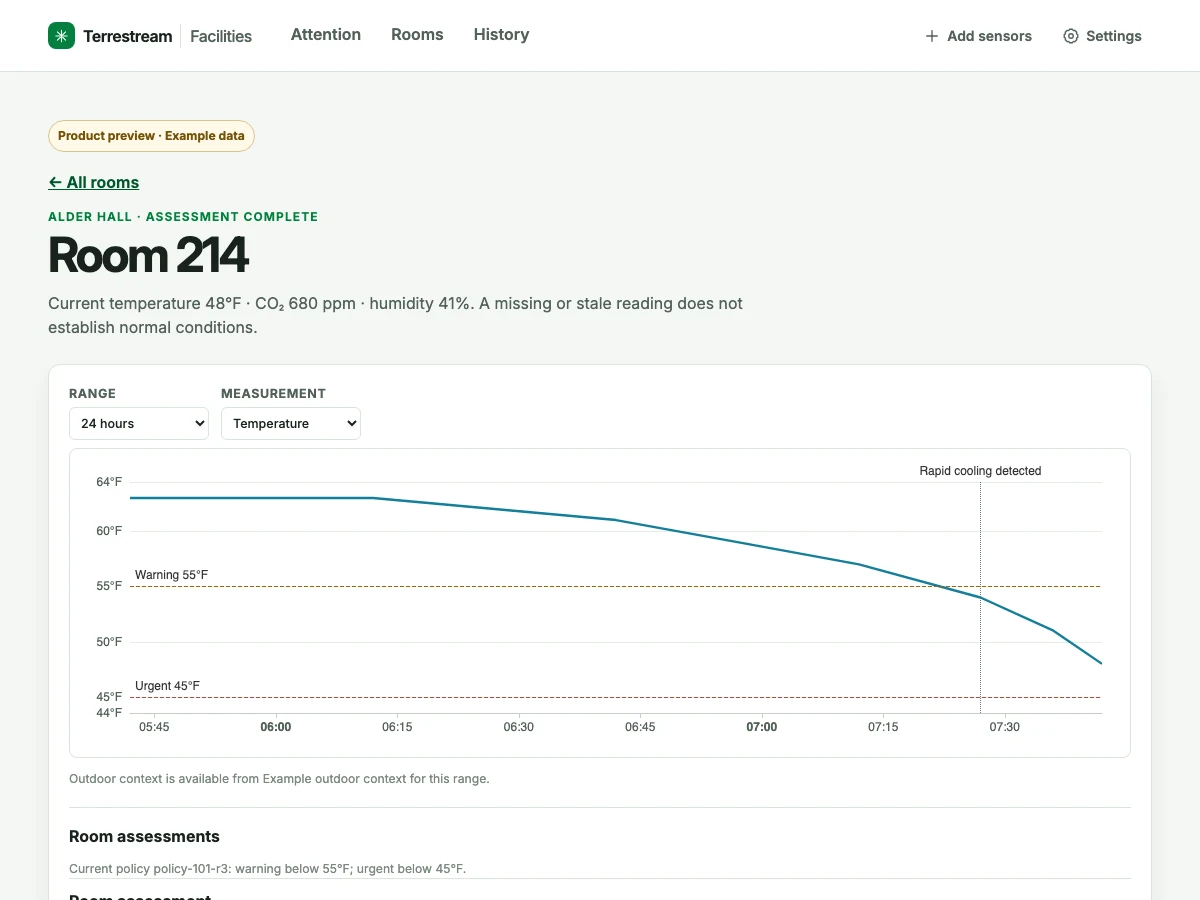
Surface stuck baselines, placement problems, and rooms that keep producing the same source pattern.
Outliers + baselinesBreathe Better. Live Smarter.
One device. Twelve signals. Useful guidance for the spaces you care about.
249 $ US one-time
Order yoursSix sensors. Twelve signals.
Built on genuine Sensirion, Bosch, and Texas Instruments sensors.
Included
Recherchez dans la base de connaissances.