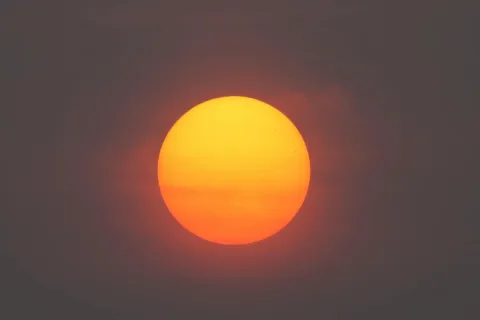


Aerosol Optical Depth (AOD) is a satellite-derived measurement of how much sunlight is scattered or absorbed by particles in a vertical column of atmosphere. A value of 0.0 means a clean atmosphere; 0.1 is slightly hazy; 0.3 is meaningfully dusty or smoky; 0.5 and above usually indicates a serious event like a wildfire plume or a major dust storm; 1.0 and above is extreme. The NASA Earth Observatory AOD maps are the canonical visualization.
AOD is not directly comparable to ground-level PM2.5, but it correlates strongly. The relationship varies with the height of the aerosol layer: a smoke plume aloft can show high AOD while ground PM stays moderate, and vice versa. Levy et al. documented MODIS-based retrieval algorithms and the correlation patterns. AOD is a satellite product, fusing satellite and ground data into a unified estimate.
For understanding regional events, AOD provides context that ground sensors cannot. When local AOD jumps from 0.1 to 0.5 over a few hours (on the public satellite maps above), a large aerosol event is moving through the region, and outdoor PM2.5 typically rises within hours even before an indoor sensor sees it. AOD trends over days catch slow-developing events like prolonged dust transport that ground-station networks may underreport.
The app and web dashboard do not display AOD, and it is not one of the fields the Google Air Quality API reports. Terrestream does read the modeled AOD from Open-Meteo's air-quality data, but only as supporting evidence: a high value alongside a smoke watch can prompt a heads-up that smoke may be passing overhead before it reaches the ground. Its window and filtration advice rests mainly on outdoor PM2.5, which captures the ground-level effect of these aerosol events; when it rises, Terrestream suggests closing windows and running filtration. AOD is the wider-angle view behind that same story. See related: wildfire smoke, mineral dust events, visibility as air quality.
References
- NASA Earth Observatory - Aerosol Optical Depth earthobservatory.nasa.gov
- Open-Meteo - Air Quality API documentation open-meteo.com
- Copernicus CAMS - Global atmosphere monitoring atmosphere.copernicus.eu
- Levy et al. - MODIS aerosol retrieval doi.org