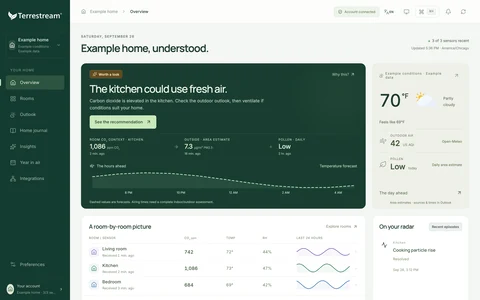

Terrestream's recommendations are not improvised. A fixed set of rules compares your readings with each room's usual levels, published thresholds, and outdoor data, and every recommendation it can make has pre-approved wording. A language model may rephrase some text, but it does not decide what to recommend. In the app, a situation's details can show a confidence label: high, medium, or low. It is a coarse label for how uncertain the evidence behind that situation is, not a measure of how bad the air is.
High confidence usually means several signals agree: for example, indoor PM2.5 is rising while outdoor particles are high and nothing inside explains it. Medium usually means the signal is real but could have more than one cause, so the right step is to check the room first (was something cooked, cleaned, painted, or unboxed?). Low usually means the evidence is thin: one channel moved, or the reading sits near a band edge rather than across it. See how anomaly detection works for changes that match no known pattern.
When a reading looks like a sensor fault rather than a real change, for example a value frozen for hours where it would normally move, Terrestream holds air-quality alerts based on it until it recovers; see cross-sensitivities for other ways the SEN66 can mislead. Terrestream does not ask about medical conditions, pregnancy, or anything else about your health, and it uses the same bands for every household. Whether you or someone at home needs a stricter target than the published guidelines is a question for a clinician.
Confidence rises when multiple sensors agree, when outdoor data corroborate an indoor reading, when the pattern matches a known one (cooking, cleaning, smoke infiltration, shower humidity), and when a published threshold is clearly exceeded. It falls when only one channel moves, when the source could be several different things, and when the reading is near a threshold rather than across it. No confidence label turns a recommendation into a medical interpretation, an individual prognosis, or a life-safety conclusion; those belong to a clinician or to the dedicated alarm on the ceiling.
This is environmental information, not medical advice. The dashboard's readings help you make decisions about the air in your space. They do not diagnose conditions, interpret symptoms, or replace conversations with your physician. If symptoms persist, worsen, or coincide with a known exposure, talk to a healthcare professional. See what Terrestream's advice covers.
References
- WHO Global Air Quality Guidelines (2021) www.who.int
- ASHRAE Standard 62.2 - Residential ventilation www.ashrae.org
- Allen et al. - COGfx ventilation and cognition study doi.org
- Open-Meteo - Air Quality API documentation open-meteo.com