
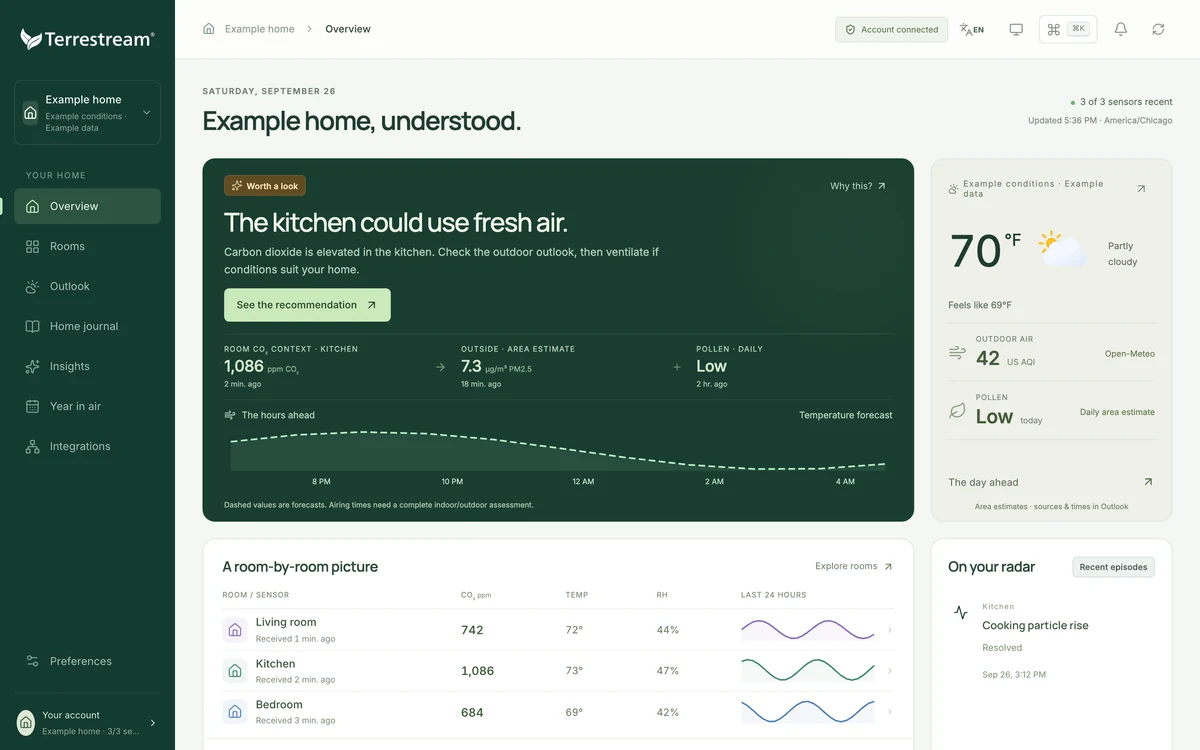
The dashboard and the apps use a small set of words with specific meanings. Knowing them makes the readings and recommendations easier to trust, and easier to question. Band: the color range a reading falls in (green, yellow, orange, red, purple or maroon), using the same thresholds as the device screen. For CO2, green runs to 600 ppm, yellow to 1,000, orange to 1,500, red to 2,000 and purple to 2,500. For the IAQ index, the bands follow the EPA AQI breakpoints (0–50 green, 51–100 yellow, and so on). The mobile apps may pair the color with a plain word and use the same thresholds; the web dashboard shows the readings themselves rather than band colors.
Baseline: what is normal for this room. Terrestream works it out from the room's own history: a short-term baseline weighted toward the last couple of hours, used to spot sudden changes, and hour-of-day patterns built from the last few weeks, used for slower comparisons. A new sensor needs a few days of data before those comparisons mean much. The VOC and NOx indexes carry their own baseline from the sensor: 100 is the VOC index's normal, and 1 is the NOx index's normal. Spike: a sudden jump that is large compared with the room's normal variation. Small wiggles are sensor noise, not spikes.
Trend: a sustained rise or fall that stands out clearly from the noise, rather than a single jump. The slow overnight CO2 climb in a closed bedroom is a trend; a ten-minute VOC pulse from a cleaning spray is not. Anomaly: a reading that is unusual for this room compared with its own history, such as CO2 well above the room's usual level for that time of day. An anomaly is a prompt to look, not a diagnosis. Fingerprint: the combination of signals that identifies a known situation, such as cooking (VOC and particles rising together, with NOx too when a gas burner is on). When a pattern does not match a known source, Terrestream does not invent one. The co-movement patterns article covers the common fingerprints.
Cross-reference: a check of your indoor reading against outdoor conditions, with air quality from the Google Air Quality API or Open-Meteo, pollen from Google's Pollen API and weather from Open-Meteo. It is how the app tells smoke coming in from outside apart from a source inside the room. Confidence: how strongly the evidence supports an interpretation. The apps show it as high, medium or low; the web dashboard lists the underlying value, from 0 to 1, in a recommendation's diagnostic details. Low confidence does not mean wrong. It means the evidence is thin, ambiguous or close to a boundary, and Terrestream shows that rather than hiding it.
References
- Sensirion - SEN66 datasheet and VOC index info sensirion.com
- Sensirion - NOx index info note sensirion.com
- EPA - AirNow: AQI Basics www.airnow.gov
- WHO Global Air Quality Guidelines (2021) www.who.int