
When the homework gets harder at 4 PM, check the CO₂

Closed door, one kid, two or three hours of after-school homework in a small bedroom. The cognitive-science literature predicts exactly the focus collapse parents see, and the dashboard usually shows the cause.

Also in: Français Español

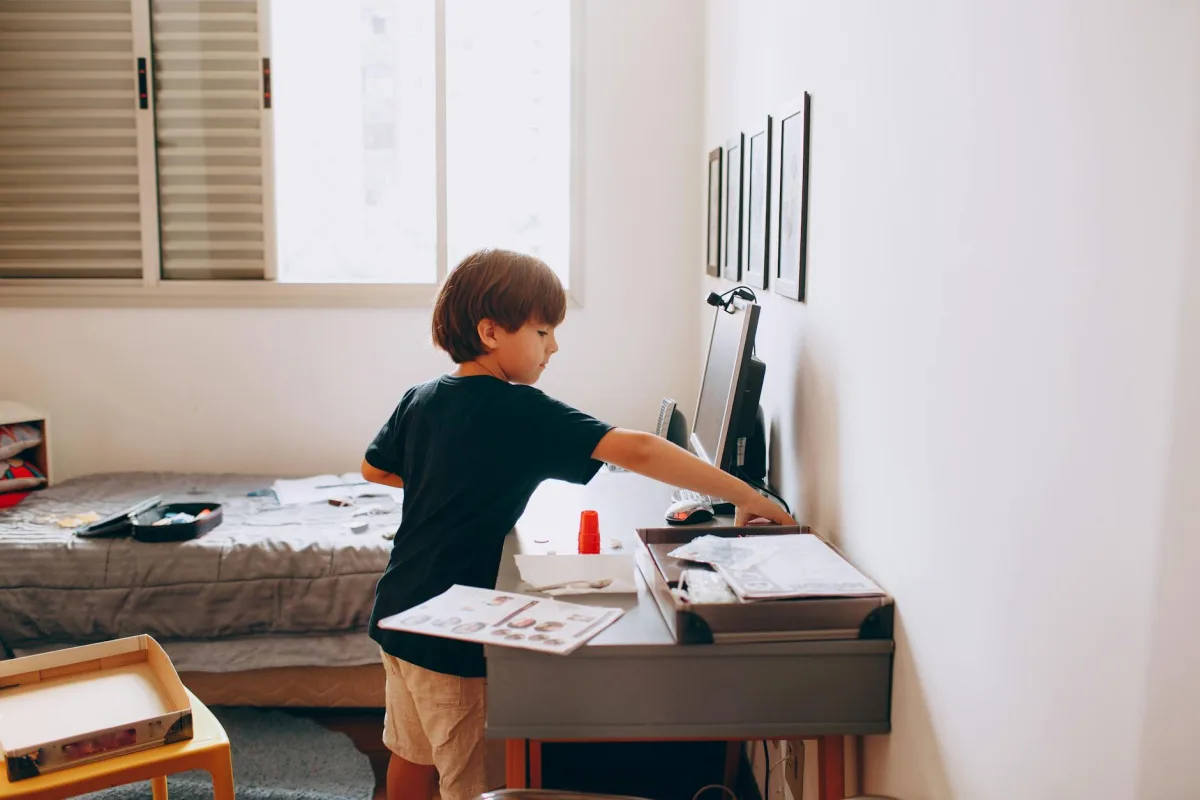
A child at a small desk in a bedroom doing homework with the door closed, late afternoon light through one window, a CO₂ reading visible on a phone screen on the desk.
Photo: Helena Lopes via Pexels
sparkline-demo Interactive chart - coming soon
Afternoon CO<sub>2</sub> trace in a 9 m² bedroom with door closed: 600 ppm at 3:30 PM, 1,400 ppm by 4:30 PM, 2,100 ppm by 5:15 PM. Concentration scores in self-reported journals drop in lockstep.

The classroom-CO2 literature is unusually consistent. Allen 2016 (Harvard COGfx) and Satish 2012 (LBNL) established the chamber-study dose-response: cognitive function drops measurably and monotonically as CO2 rises from 600 to 1,400 ppm in otherwise-identical air. Classroom-specific field studies replicated the effect in the wild: rooms running above 1,000 ppm CO2 correlate with measurable drops in standardized test scores, attendance, and teacher-rated attention. The mechanism is contested but the empirical signal is not; see cognitive effects of CO2 for the deeper review and classroom CO2 and learning for the school-context implications.

A child's after-school homework hour is the same physics with smaller geometry. Take a 9 m² (roughly 100 ft²) bedroom with the door closed, one occupant, no mechanical ventilation, no open window. A school-aged kid exhales somewhere around 4 to 6 L of CO2 per hour at rest. The room's air volume is on the order of 22,000 L, the door seal exchanges air at maybe 0.1 to 0.3 air changes per hour, and the math says CO2 will climb from outdoor baseline (~420 ppm) to 1,500-2,500 ppm over two to three hours. That is exactly the trajectory the dashboard shows in family homes; the spike is reliably timed to "kid gets home from school, closes the door to study." The cognitive load of the homework itself compounds the effect, because demanding executive function in a CO2-impaired prefrontal cortex is a fight against the same physiology the chamber studies measured.

Children's physiology amplifies the per-room effect. School-aged kids have a higher respiratory rate per kg of body mass than adults, which means they produce more CO2 per cubic meter of room space at the same body size; Harvard's healthy-buildings work on children's exposure-to-mass ratios documents the gap. The result: a "homework corner" that would peak at 1,200 ppm with an adult writing emails in it can peak at 1,800-2,200 ppm with a kid doing math. And kids are less likely to attribute the focus loss to the air; they will frame it as "I am bad at math" or "I cannot pay attention" rather than "the room got stuffy." Reframing this for the kid is part of the value of having a dashboard in view during homework time: you are not lazy, the air is stuffy, here is what to do about it.

The interventions are simple and additive. Open the door if at all possible; the rest of the house is a ventilation reservoir and just cracking the door drops a homework-room CO2 trace by 300-600 ppm within 15 minutes. Crack a window when weather permits; even an inch of opening triples the air-change rate in most bedrooms. Set a 1,000 ppm dashboard notification on the homework room so the kid (or parent) sees the threshold cross in real time and responds. Build a "study-then-walk-around" rhythm on 25-minute intervals (the Pomodoro structure works perfectly for this), which doubles as a ventilation reset because opening the door to leave the room re-mixes the air. Watch for the seasonal worst case, which is the closed-window December-through-February stretch when heating is on and outdoor temperature discourages window-cracking; that is when the worst homework traces in any dataset live. See CO2 for the metric basics, reducing CO2 indoors for the playbook, CO2 rebreathing detection for how to spot the pattern, children and air quality for the broader demographic context, and bedroom overnight for the closely related sleep-room case.

This is environmental information, not medical advice. The dashboard's readings help you make decisions about the air in your space. They do not diagnose conditions, interpret symptoms, or replace conversations with your physician. If symptoms persist, worsen, or coincide with a known exposure, talk to a healthcare professional. See the AI's medical-advice scope.

References

  1. Allen et al. - COGfx ventilation and cognition study doi.org
  2. Satish et al. - CO₂ and decision-making performance doi.org
  3. Bakó-Biró et al. - Classroom CO₂ and pupil performance doi.org
  4. Harvard Healthy Buildings - IAQ and children healthybuildings.hsph.harvard.edu