

After a source event ends, every pollutant decays toward its background level, but the shape of the decay differs by physics. The shape is also a clue: an indoor event such as cooking clears once the source stops, while smoke getting in from outside keeps coming back until the outdoor air improves, even when the peak PM2.5 looks similar.
The core math is first-order decay: concentration falls exponentially with time, at a rate set by the air changes per hour (ACH), where one air change replaces the room's volume once. Two contributions add together: passive air exchange (typically 0.2–0.5 ACH in a well-sealed home, more with windows open) plus filtration from any purifier. A purifier adds its CADR in cfm × 60 ÷ the room volume in cubic feet: a 300-CADR purifier in a 1,500 ft³ room adds about 12 ACH.
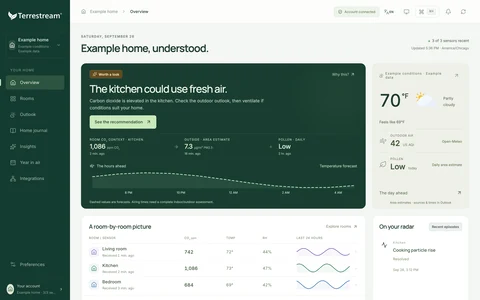
The half-life of a contaminant is about 0.693 ÷ total ACH, in hours. At 4 ACH (a typical HEPA purifier in a moderately sized room), the half-life is about 10 minutes, with a 95% reduction in about 45 minutes. At 8 to 10 ACH (a well-sized HEPA in a small bedroom), the half-life drops to 4 or 5 minutes. Terrestream can estimate each room's own air-change rate from how CO2 falls after people leave; it needs several clean decays, usually over a few days, before it relies on one, and it uses the estimate to flag rooms that clear slowly rather than displaying the number.
PM and CO2 both decay roughly exponentially when the source stops and ventilation stays steady. Coarse PM10 often drops faster at first as the heaviest particles settle, then follows a slower tail. VOCs are two-stage: walls, fabric, and carpet absorb VOCs quickly during a pulse and release them slowly over hours to days, so after a ten-minute cooking event the VOC index usually falls most of the way back within half an hour but can stay a little above its starting point for hours.
Humidity decays slowly compared with gases because hygroscopic materials such as wood, paper, and fabric absorb and release water. A shower spike falls faster than it built while the bathroom fan runs, but the room takes longer to dry below its starting humidity than a gas calculation would predict.
Three caveats. First, the math assumes well-mixed air; closed doors, dead zones, and poor mixing slow real-world clearance. Second, settled particles (PM10, dander) get stirred back up by movement, so a room may clear and then spike again when someone walks in. Third, sources can continue (a still-warm pan, off-gassing furniture), and decay only starts when the source stops. Rated CADR comes from standard laboratory tests; real rooms often clear more slowly. See HEPA and CADR.
References
- AHAM Verifide - Air filtration standards (CADR) ahamverifide.org
- EPA - Guide to air cleaners in the home www.epa.gov
- ASHRAE - Handbook of Fundamentals www.ashrae.org
- ASHRAE Standard 62.2 - Residential ventilation www.ashrae.org
- Persily - Indoor CO₂ and ventilation doi.org