

Public health uses three words with specific meanings that get conflated in casual conversation. Air-quality interpretation goes better when they are kept apart. Hazard is the intrinsic potential of a substance to cause harm; PM2.5 is a hazard, ozone is a hazard, CO is a hazard. The hazard is a property of the substance.
Exposure is the actual contact between a person and a hazard, integrated over time. Two people in different rooms of the same house can have very different exposures to the same hazard if one is in the kitchen during cooking and the other is in a sealed bedroom. Exposure is the property the sensor measures most directly.
Risk is the probability that an actual adverse outcome occurs, given the hazard and the exposure. Risk depends on dose-response (how much exposure produces how much harm), on individual susceptibility (asthma, age, cardiovascular history), and on context (chronic vs acute, presence of co-exposures). EPA and the WHO risk-assessment toolkit formalize the relationship.
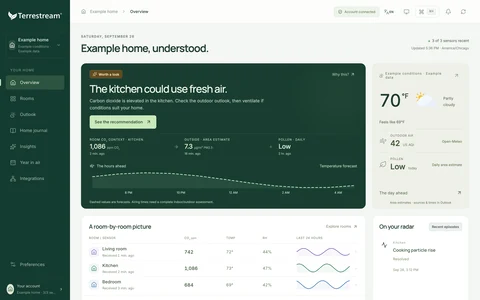
Terrestream respects the distinction. When it reports "PM2.5 elevated", that is exposure. It does not weigh notifications by anyone's health: there is no household health profile, so moving from exposure to personal risk is a judgment for you and your clinician. When it suggests an intervention, it acts on the exposure it can measure, such as closing windows and filtering when outdoor particles are getting in. Casual conversation slides freely between the three; careful conversation does not.
References
- WHO - Human health risk assessment toolkit www.who.int
- EPA - About risk assessment www.epa.gov
- NCRP - Risk assessment publications ncrponline.org
- WHO Global Air Quality Guidelines (2021) www.who.int