

Bringing outdoor air indoors is how you dilute everything: CO2 from breathing, VOCs from materials, humidity from showering, residual particulates from cooking. The four common approaches make different tradeoffs between energy efficiency, control, and source-targeting.
Natural ventilation (open windows, trickle vents): free, no equipment, no energy penalty for the air exchange itself. Cost: zero control over rate or quality. Open a window on an ozone-high or pollen-high day and you import the problem. Best as a supplement when outdoor conditions are favorable; see open vs closed windows.
Range hoods are source-specific local exhaust ventilation: they remove cooking emissions at the source, before they distribute through the home. The single highest-leverage ventilation upgrade for households that cook with gas. Limitation: only addresses the kitchen, only while it is running, and only if the hood actually vents outdoors rather than recirculating. Range hood details.
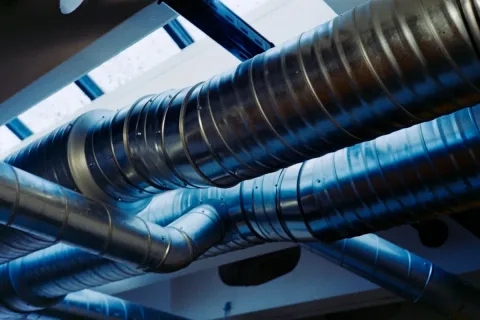
Heat or Energy Recovery Ventilators (HRV/ERV) are balanced mechanical ventilation: they push stale air out and pull fresh air in through a heat exchanger, recovering 70 to 90% of the temperature differential. The standard answer in tight new homes and in cold climates where opening windows in winter is a losing proposition. Demand-controlled ventilation (commercial) dynamically adjusts outdoor-air intake based on actual occupancy via CO2 sensors. DCV details. For most residential users, the practical answer is: range hood for cooking, natural for nice days, HRV/ERV for everything else if you have one.
References
- ASHRAE Standard 62.1 - Ventilation for Acceptable Indoor Air Quality www.ashrae.org
- ASHRAE Standard 62.2 - Residential ventilation www.ashrae.org
- Fisk & de Almeida (LBNL) - Sensor-based demand-controlled ventilation: a review doi.org
- Singer et al. (LBNL) - Performance of installed cooking exhaust devices doi.org