
Weekdays and weekends look different in most homes. Most households spend Monday through Friday daytime at school or work, returning in the evening, and Saturday/Sunday at home. The air-quality pattern follows: weekday days are low-occupancy and low-event, evenings spike for cooking and cleanup, weekends are higher-occupancy throughout with concentrated meal and cleaning events.
CO2 tracks the schedule almost exactly. A weekday-empty home settles within a few degrees of outdoor CO2 by mid-afternoon; on weekends it spends much of the day at 800-1,200 ppm depending on activity. VOC patterns shift toward weekends: people cook more, clean more, and host more. PM2.5 events from cooking cluster on weekend evenings and Saturday lunches in many households.
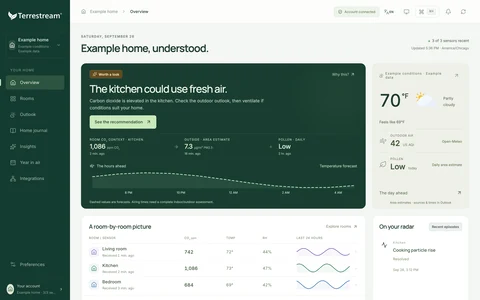
For CO2, Terrestream builds each room's usual pattern from its own history, hour by hour and day by day, and can tell you when CO2 is above that room's usual pattern or when a room often gets stuffy around a certain time. A 1,400 ppm reading on Tuesday at 2 PM stands out in a home that is usually empty then (someone is home unexpectedly, or the HVAC is starved for outdoor air); the same reading on Sunday at 2 PM may be ordinary for that room.
Remote and hybrid workers break the standard pattern. A household with a full-time work-from-home occupant shows weekday-daytime CO2 profiles closer to weekend patterns; an empty-house pattern is the unusual one. Because the routine is learned from each room's own history, it follows a new schedule without any configuration. Holiday weeks, school breaks, and travel weeks produce their own distinct patterns.
References
- Klepeis et al. - National Human Activity Pattern Survey doi.org
- LBNL Indoor Air Quality science portal iaqscience.lbl.gov
- EPA - Improving indoor air quality www.epa.gov
- Persily - Indoor CO₂ and ventilation doi.org