

A common second question after "is my air bad?" is "how does my home compare?" Population-level studies provide the distribution, and your readings let you see where your home sits on it. The most-cited population study is Klepeis et al. (NHAPS), which characterized how Americans actually spend their time indoors; LBNL's Indoor Air Quality science portal compiles updated home-air-quality distributions.
A typical North American single-family home with average occupancy reads in roughly the following bands when averaged over a month: CO2 600 to 1,100 ppm, PM2.5 5 to 15 µg/m³, VOC index 80 to 150, RH 30 to 55%, temperature 19 to 23 °C. Apartments tend to run higher on CO2 and humidity (denser occupancy, smaller air volumes, less envelope leakage) and lower on PM (less outdoor infiltration through smaller window-to-wall ratios).
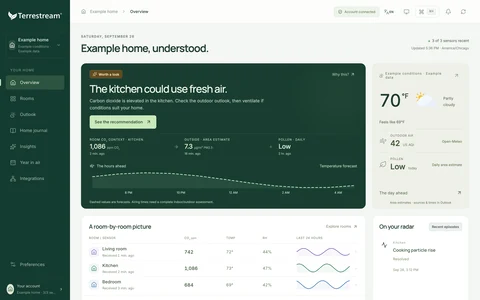
Your placement on the distribution matters less than the trend over time. A home in the 75th percentile for PM2.5 that is steadily improving (because you installed HEPA, fixed a flue, or got a new range hood) is going in the right direction. A home in the 30th percentile that is drifting upward (a humidifier set too high, a slow basement leak, a new piece of off-gassing furniture) is worth investigating. Your history in the app and web dashboard shows the trajectory, and Terrestream flags some slow trends on its own, such as air clearing more slowly over time or rising moisture risk.
Benchmarking is most useful when paired with a goal: WHO 2021 PM2.5 annual (5 µg/m³) is a target. Health Canada's residential CO2 guideline uses a 1,000 ppm 24-hour limit; interpret shorter occupied-room readings with the outdoor baseline and occupancy. 30 to 50% RH (see humidity) is a target. Percent of time within a target band is the practical way to track progress. Terrestream does not show that percentage; the web dashboard's room calendar shows whether each day's average stayed below a watch level, and those watch levels are not all the same as these targets.
References
- Klepeis et al. - National Human Activity Pattern Survey doi.org
- EPA - Improving indoor air quality www.epa.gov
- WHO Global Air Quality Guidelines (2021) www.who.int
- LBNL Indoor Air Quality science portal iaqscience.lbl.gov