
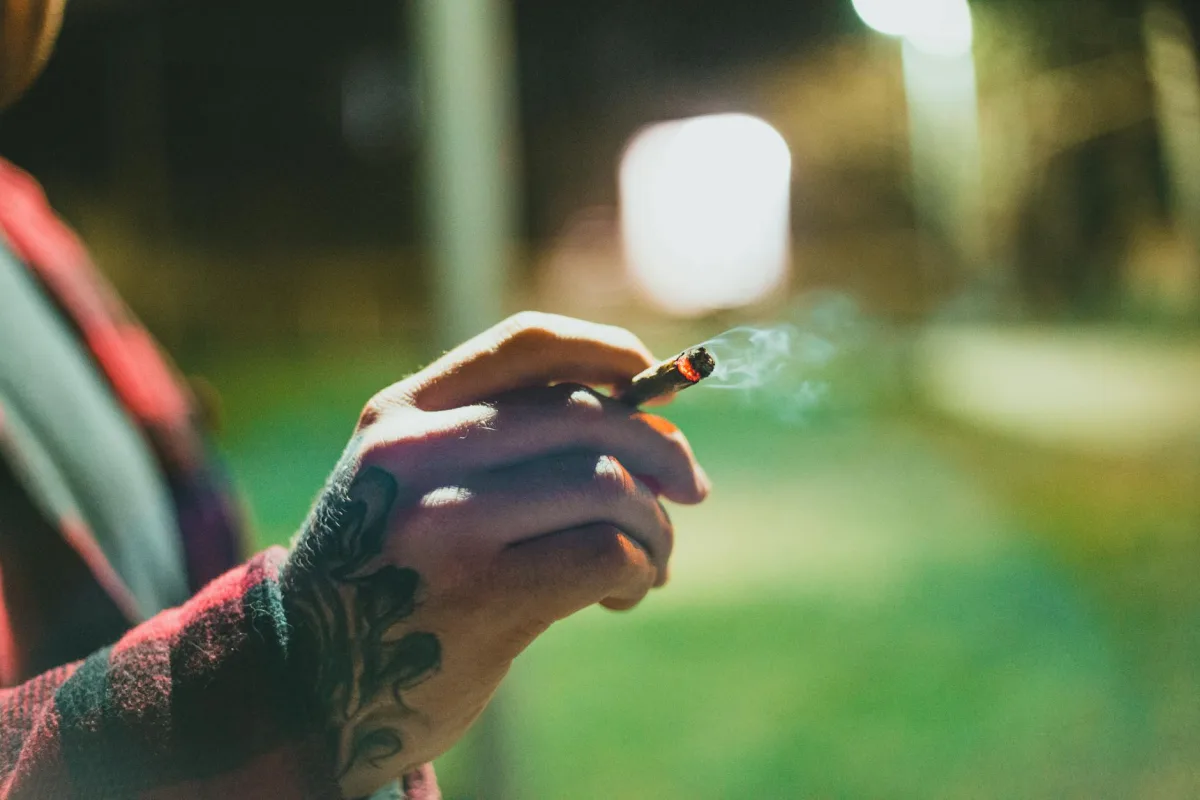
La fumée est de la fumée. Brûler de la matière organique à la température d'une source tenue à la main (700 à 900 °C pour une cigarette, similaire ou légèrement plus bas pour un joint ou un fourneau de pipe) produit les mêmes familles générales de produits : particules fines et ultrafines (la plupart sous 1 µm, voir PM2,5 et particules ultrafines), monoxyde de carbone, hydrocarbures aromatiques polycycliques (HAP), benzène et autres aromatiques, formaldéhyde et acétaldéhyde, et une longue traîne de produits de combustion partielle. Les résumés des CDC et le profil de fumée de cannabis de l'ATSDR s'accordent à dire que la chimie de combustion de la fumée de cannabis est largement similaire à celle du tabac, avec des composés propres au cannabis (THC, CBD, cannabinoïdes mineurs, terpènes) ajoutés plutôt que substitués. Le tableau de bord lit une séance de cannabis comme une pointe nette de PM2,5, une élévation mesurable de l'indice COV, et une bosse de CO si la séance est assez longue ou la pièce assez petite.
La concentration dépend de la méthode et du produit. Un seul joint livre plus de masse totale de fumée par séance qu'une seule cigarette parce qu'il est typiquement plus gros et fumé sans filtre ; une séance de bang modère légèrement les particules par filtration à l'eau mais fait peu pour les COV ou le CO ; une pipe en verre est la plus haute en particules par bouffée de toute méthode. Les concentrés (wax, shatter, live resin, cartouches de vapotage) inversent le profil : la combustion est remplacée par la vaporisation à plus basse température, donc l'émission de PM chute abruptement, mais l'émission de COV peut monter parce que les concentrés vaporisés relâchent terpènes et solvants d'extraction résiduels (butane, propane, éthanol selon le procédé). Les blunts (cannabis enveloppé dans une feuille de tabac) combinent les deux profils : émission complète de fumée de tabac plus émission complète de fumée de cannabis. La signature du tableau de bord lors d'une séance longue à forte concentration est une montée nette de PM qui décroît sur 30 à 90 minutes appariée à une élévation de l'indice COV qui décroît bien plus lentement, souvent 4 à 8 heures.
La légalité a changé plus vite que la pratique de ventilation. Le cannabis est maintenant légal pour usage récréatif chez l'adulte dans 24 États américains et le district de Columbia, plus tout le Canada à l'échelle nationale ; légal pour usage médical dans des juridictions additionnelles ; et interdit au fédéral aux États-Unis, ce qui complique le droit propriétaire-locataire en particulier. Dans la plupart des juridictions, une résidence privée (maison unifamiliale) peut légalement permettre la combustion de cannabis à l'intérieur ; les aires communes en multilogements habituellement non, et les règles unité par unité varient selon le bail et les règlements de condo. Le problème pratique de QAI est que l'odeur de cannabis et les produits de combustion migrent à travers les CVCA partagés, les espaces sous les portes de corridors et les conduits de ventilateurs de salles de bain, et « le cannabis de mon voisin est dans mon unité » est l'une des principales plaintes uniques en QAI multilogements. Voir l'article sur le vapotage et le tabagisme pour les parallèles de patron au tableau de bord avec le tabac.
Ventilation qui fonctionne réellement pour les séances de cannabis : ouvrir une fenêtre et faire tourner un ventilateur d'extraction dans la même pièce (ventilation traversante, pas juste une fenêtre entrouverte), éviter les séances dans la chambre (la traîne COV post-séance restera dans la pièce des heures et vous la respirerez la nuit ; voir chambre la nuit), ne pas utiliser de générateurs d'ozone ou de sprays « élimine-odeurs » comme substitut (l'ozone est lui-même un irritant respiratoire, voir l'article de sécurité pertinent), et faire tourner un filtre CVCA à MERV 13 ou plus entre les séances pour évacuer le résiduel particulaire. Pour les ménages soucieux d'exposition secondaire avec enfants, traitez la combustion de cannabis comme la combustion de cigarette : à l'extérieur, sous le vent, et pas dans l'aire de vie familiale. Le NIDA couvre la littérature sur l'exposition secondaire ; les doses livrées aux spectateurs passifs sont plus basses que pour le tabac à une intensité d'usage occasionnel typique, similaires à une intensité d'usage quotidien intense. Pour la gestion plus large des COV, voir réduire les COV à l'intérieur et pour les sources de combustion en général voir produits nettoyants côté source chimique.
Il s'agit de conseils généraux, non d'un substitut à une évaluation professionnelle de votre habitation particulière. Les interventions majeures (refonte du CVCA, étanchéité d'une enveloppe perméable, remédiation des moisissures, travaux électriques pour ventilateurs ou évents) doivent être réalisées par un professionnel certifié. Pour les problèmes chroniques qui ne répondent pas aux étapes décrites ici, voir quand appeler un professionnel.
Références
- CDC - Effets du cannabis sur la santé www.cdc.gov
- ATSDR - Effets sanitaires de la fumée de cannabis www.atsdr.cdc.gov
- NIDA - Recherche sur le cannabis (marijuana) nida.nih.gov
- Washington Post - Fumée secondaire de cannabis www.washingtonpost.com