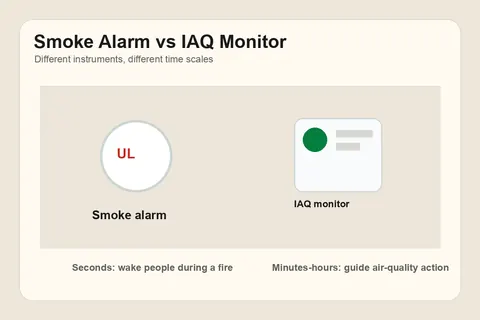

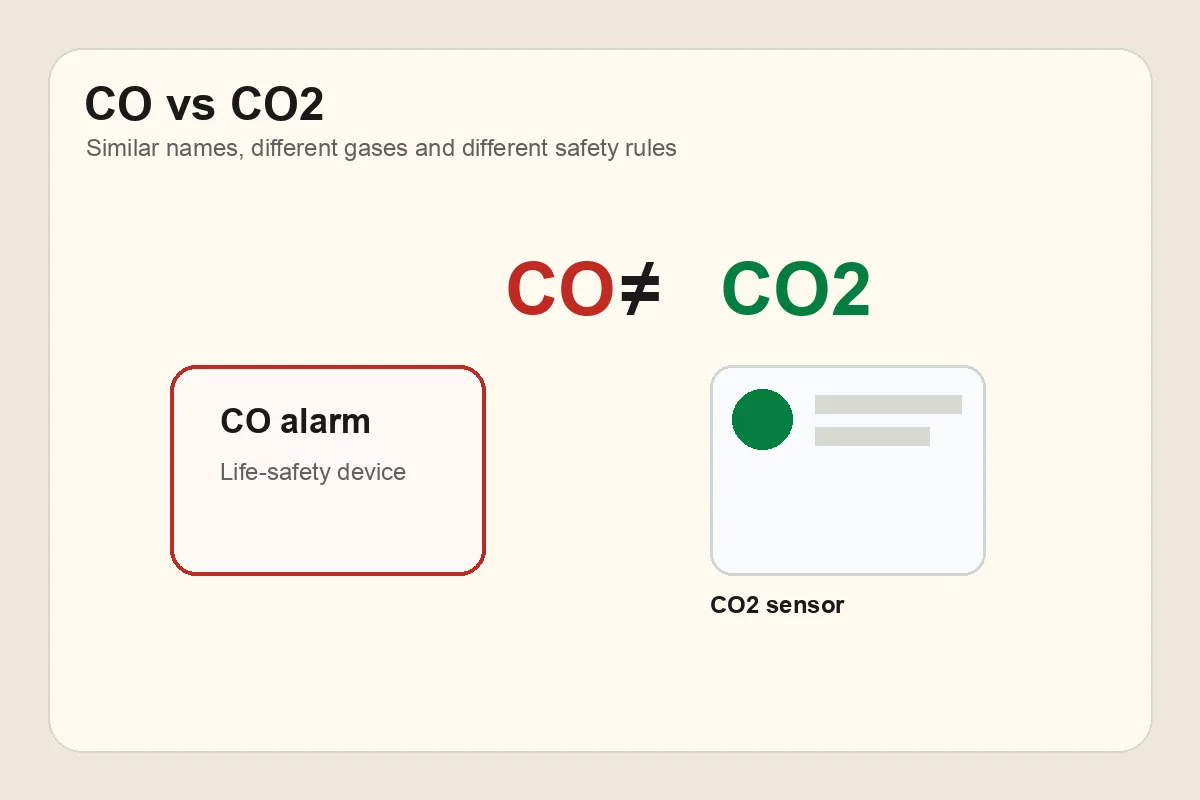
This is the most important point on this entire site, so it goes first: Terrestream is not a carbon-monoxide alarm. Terrestream is not a smoke alarm. Terrestream is not a life-safety device. If your house catches fire, or if a furnace flue is leaking carbon monoxide, this sensor will not save your life. Every home (every home, no exceptions) needs a UL 2034 or CSA 6.19 carbon-monoxide alarm and a UL 217 smoke alarm. Those are the devices that save lives. Terrestream lives next to them, not instead of them.
The two gases are chemically and physiologically nothing alike. Carbon dioxide (CO2) is the gas you exhale. Outdoor air is around 420 ppm; indoor rooms with people in them sit between 600 and 1,500 ppm. At those levels CO2 is not dangerous. At worst you get drowsy and unfocused. It becomes acutely toxic only above 40,000 ppm, a level you will never see in a residence.
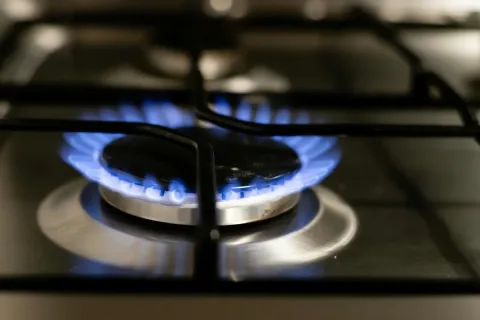
Carbon monoxide (CO) is a byproduct of incomplete combustion: a furnace running with a blocked flue, a car running in an attached garage, a propane heater in a sealed room, a generator too close to a window. It is invisible, odorless, and binds to hemoglobin 200× more tightly than oxygen. According to the CDC, over 400 Americans die from accidental CO poisoning every year and over 100,000 are hospitalized. The toxic threshold is in parts per million; not tens of thousands.
The Sensirion SEN66 inside Terrestream measures CO2 via photoacoustic infrared spectroscopy: an infrared source pulses at the 4.26 µm wavelength CO2 absorbs, and a sensitive microphone picks up the resulting pressure wave inside a tiny chamber. It cannot see CO. There is no firmware update, no calibration, no software trick that will make this device detect CO. If you want CO detection, buy a CO alarm. They cost $25–60, they last seven to ten years, and they will wake you up if they need to.
Why have a Terrestream at all, then? Because most of what affects you indoors is not immediate-death dangerous. It is the slow accumulation of CO2, fine particulates, gas-stove NOx, cleaning-product VOCs, dust mites, and outdoor pollen. The life-safety alarms cover the cliffs. Terrestream covers the slope.
References
- CDC - Carbon monoxide poisoning FAQs www.cdc.gov
- EPA - Carbon monoxide's impact on indoor air quality www.epa.gov
- UL 2034 - Single and Multiple Station CO Alarms www.shopulstandards.com
- NFPA 720 - CO detection installation standard www.nfpa.org
- CSA 6.19-17 - Residential carbon monoxide alarming devices www.csagroup.org