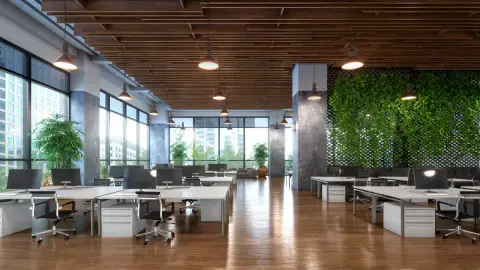


A commercial office is a more predictable IAQ environment than a home, and for most occupants a worse-performing one. CO2 follows a familiar curve: 420–450 ppm at 7 a.m. when the building wakes up, climbing through the morning as people arrive, and peaking in conference rooms in mid to late afternoon at 900–1,500 ppm or more. The ASHRAE 62.1 office rate combines 5 cfm of outdoor air per person with 0.06 cfm per square foot; the resulting CO2 depends on occupancy, activity, outdoor CO2, and mixing, so 1,000 ppm is not a fixed compliance target.
Meeting rooms are where the math gets unforgiving. Eight adults breathe out roughly 140 liters of CO2 an hour. In a sealed 50 m³ room that would add close to 3,000 ppm per hour; real rooms leak and ventilate, so the rise is slower, but a small closed room can pass 1,500–2,000 ppm within an hour. In a steady occupied room, the indoor-outdoor CO2 difference shows whether ventilation is keeping pace. ASHRAE's position document on indoor CO2 ties the familiar 1,000 ppm mark to roughly 8 L/s (16 cfm) of outdoor air per person, and calls it at best an indicator of ventilation, not of acceptable air quality. Actual delivery depends on schedules, dampers, and economizer settings, and on whether controls follow real occupancy.
The cognitive question is real but easy to overstate. In controlled chamber studies, Satish et al. and the Harvard COGfx study (Allen et al.) found lower decision-making scores under higher-CO2 or lower-ventilation conditions; later studies have been mixed. Treat CO2 first as a signal of ventilation, and schedule demanding meetings in rooms that stay fresh.
VOC sources in offices look different from homes: cleaning products on a contractor schedule (evenings or early mornings), toner and ozone near high-volume laser printers, and new furniture, carpet, and partitions that off-gas formaldehyde and other VOCs for weeks to months after a build-out. Outdoor air matters more than most workers realize: air intakes often sit near parking-garage exhaust, loading docks, or busy streets. MERV-13 filters capture most fine particles, while the MERV-8 filters many buildings still run let most PM2.5 through, so on wildfire-smoke days an office with weak filtration can be worse than the sidewalk outside.
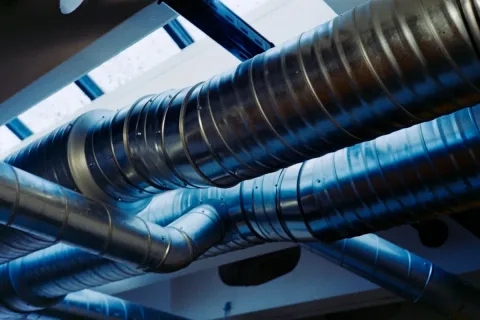
For facilities teams, monitoring turns complaints into decisions. CO2 shows ventilation stress, PM recovery shows filtration and air-change performance, the VOC and NOx indexes point to source classes, and pressure and light add context on building operation and occupancy rhythm. That supports tuning ventilation schedules, checking meeting-room recovery, prioritizing filter upgrades, and telling a one-off event from a building trend. Demand-controlled ventilation, which adjusts outdoor air to real occupancy, is how most modern offices should run.
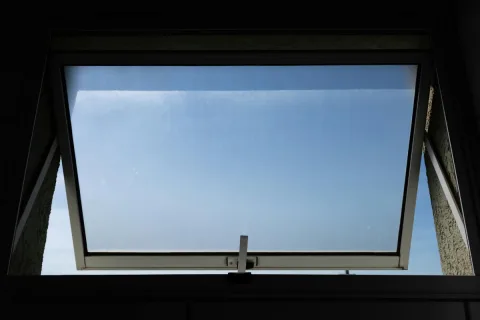
What an individual employee can do: ask facilities for the most recent IAQ assessment and the supply-air MERV rating. Open a window if your floor has operable ones, especially at midday. In meeting rooms, prop the door open, take a five-minute break every 45 minutes so the room can partly recover, or book a larger room than the headcount strictly needs. A personal HEPA purifier at the desk, sized by CADR, handles PM2.5 in your immediate breathing zone.
References
- ASHRAE Standard 62.1 - Ventilation for Acceptable Indoor Air Quality www.ashrae.org
- ASHRAE - Position document on indoor carbon dioxide www.ashrae.org
- Satish et al., LBNL - Is CO₂ an indoor pollutant? doi.org
- Allen et al. - COGfx ventilation and cognition study doi.org
- Harvard T.H. Chan - CO₂ and cognitive function healthybuildings.hsph.harvard.edu
- IWBI - What's new in WELL v2: Air resources.wellcertified.com
- EPA - Indoor air quality basics www.epa.gov