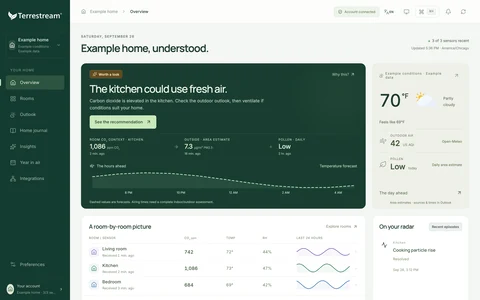


Terrestream's recommendations do a small, specific set of things. A fixed set of rules compares your readings against published thresholds and each room's usual levels, recognizes patterns it has seen before, cross-references outdoor data, and suggests actions when the data support one; the wording comes from pre-approved text, and a language model at most rephrases it. That covers most of what an air-quality tool can usefully do.
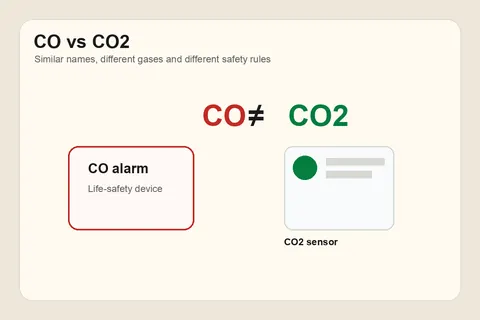
It does not do the things people sometimes ask it to. It is not a clinician: it does not diagnose asthma, allergies, or sensitivities, and it does not prescribe treatment. It is not a life-safety system: it cannot detect carbon monoxide, smoke, or natural-gas leaks (see CO vs CO₂). It is not a regulator: its outputs are advisory and not admissible as legal, medical, or workplace evidence without independent verification.
It will tell you how sure it is. In the app, each recommendation's details show a confidence level (high, medium, or low), which drops when the recommendation rests on an inference, such as air moving between rooms, or on outdoor data that is getting old. A reading that stands out from what is usual for that room is flagged as unusual, with things to check rather than a diagnosis. Several readings moving together can hint at a source (see co-movement patterns), but when the cause is uncertain the wording hedges ("possible," "if cooking") instead of asserting one. When outdoor data is missing or out of date, it says so and does not suggest opening windows.
It will also tell you about its own limits in plain terms. The sensor has cross-sensitivities. It drifts over years. It reads one point in your home, not the whole house. The outdoor reference is regional, not your block. None of that means the readings are wrong; it means the interpretation is calibrated to that uncertainty, and Terrestream says so rather than hiding it.
References
- EPA - AirNow: AQI Basics www.airnow.gov
- WHO Global Air Quality Guidelines (2021) www.who.int
- Sensirion - SEN66 environmental sensor sensirion.com
- EPA - Guide to air cleaners in the home www.epa.gov