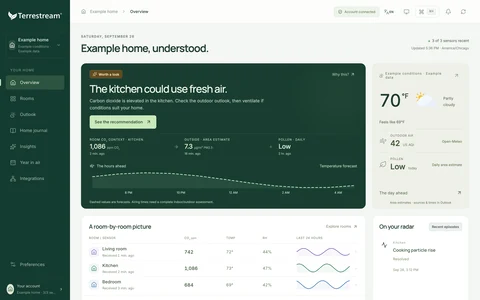


Here is the kind of message Terrestream sends: "Particles are rising. Run an air purifier and check for an indoor source." It pairs a reading with an environmental action. The Learn articles add published context, such as the WHO 24-hour guideline for PM2.5 of 15 µg/m³. Every statement stays inside what the sensors and a public-health document can support.
Here is what Terrestream does not say: "you have asthma, take a rescue inhaler now"; "you are pregnant, this CO2 level is unsafe for the fetus"; "your child's symptoms indicate a respiratory infection"; "stop taking your medication for a few days and see if symptoms improve"; "you should ask your doctor specifically about idiopathic pulmonary fibrosis." Those are medical diagnosis, prescription, prognosis, and specialist routing. Terrestream does not make them, and it asks for no health information about you.
There is one important exception, and it is yours to act on. If you notice a symptom pattern tied to a place or a time ("I get headaches only in this one room"; "my cough started the week we moved in"; "I sleep badly whenever the bedroom door is closed"), that is worth bringing to a doctor, and your Terrestream history for the same room and hours can add environmental context to that conversation. Seeking care is in scope; the diagnosis itself is not.
If you do seek care, the usual starting point is a generalist (family medicine or GP), who may refer you to an allergist for suspected allergic disease, a pulmonologist for chronic respiratory symptoms, an ENT for sinus and upper-airway complaints, or an environmental medicine specialist. Terrestream's data can inform any of those conversations; it does not replace them. For the parallel decision tree on environmental escalation (mold, radon, lead, asbestos), see when to call an IAQ pro.
References
- AMA - Digital health and AI www.ama-assn.org
- FDA - Digital Health Center of Excellence www.fda.gov
- WHO - Safe and ethical AI for health www.who.int
- AAFA - Indoor air quality and asthma aafa.org