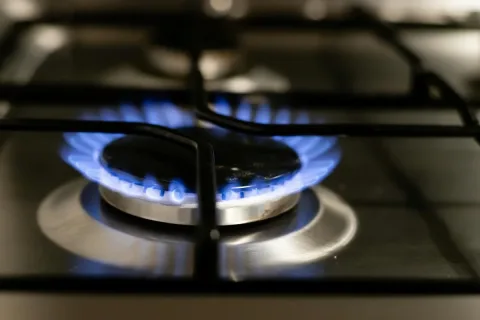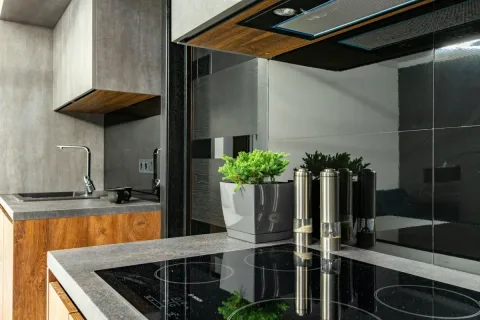


Burning natural gas on a residential cooktop is the most-studied indoor combustion source. A burner running for ten minutes produces measurable spikes in NOx (studies report tens to hundreds of ppb in the kitchen; Terrestream shows this as a rise in the NOx index, not a ppb value), PM2.5 (often 50–150 µg/m³ in the kitchen, with brief peaks higher), ultrafine particles, and a tail of combustion VOCs including formaldehyde and acrolein.
RMI and Lebel et al. document the public-health implications: gas cooking is associated with higher childhood asthma risk, and NO2 in a small, poorly ventilated kitchen can pass outdoor short-term health benchmarks within minutes of cooking. The rise is not subtle; a sensor in the next room usually sees it.
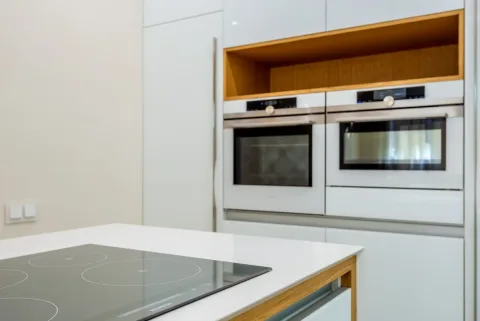
Each cooking method has its own fingerprint. Gas: NOx rises sharply when the burner lights, then PM2.5 and VOCs from the food, and humidity from steam. Induction or electric: particles and VOCs from the food alone, with no NOx rise; the missing NOx is the tell. Frying: large PM2.5 peaks from oil aerosol, dominated by small particles and sustained for the whole session. Oven roasting: a slower, VOC-heavy rise over 30 to 90 minutes. Grilling: smoke-like particles with a charred VOC signature. Terrestream recognizes cooking spikes from the combined rise, and the NOx index shows whether a gas burner was involved.
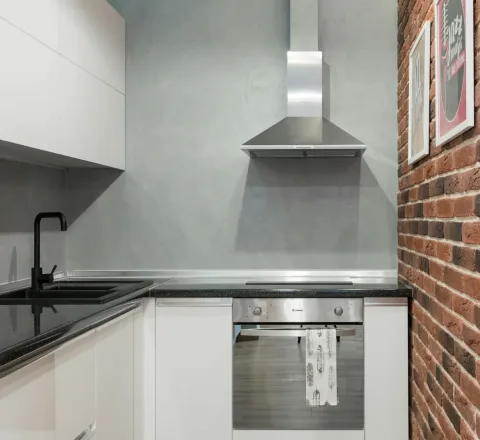
The most effective single intervention is a properly vented range hood; see the range-hood article. A hood vented outdoors, run on a higher setting and used over the back burners, captures a large share of cooktop emissions; a recirculating hood that filters and returns the air to the kitchen does not remove NOx at all. The difference shows up in the data as much smaller peaks with the hood on.
Beyond the hood, replacement is the cleanest long-term answer: induction cooktops eliminate combustion emissions while heating food fast and controllably, and after a switch, the NOx rise during cooking disappears. For renters and others who can't replace the cooktop, run HEPA filtration in adjacent living spaces and open a kitchen window during longer cooking sessions. See gas-to-electric transition.
Note on safety: gas cooking is also a minor carbon-monoxide source under poor combustion (yellow flame tips, sooting). Terrestream does not detect CO; see the CO disambiguation. Every home with a gas appliance should have a CO alarm.
References
- RMI - Gas stove pollution and health rmi.org
- Lebel et al. - Methane and NOx from natural-gas stoves doi.org
- EPA - Basic information about NO₂ www.epa.gov
- Health Canada - Residential NO₂ guideline www.canada.ca
- Singer et al. (LBNL) - Performance of installed cooking exhaust devices doi.org
- Abdullahi et al. - Cooking emissions and indoor PM (review) doi.org